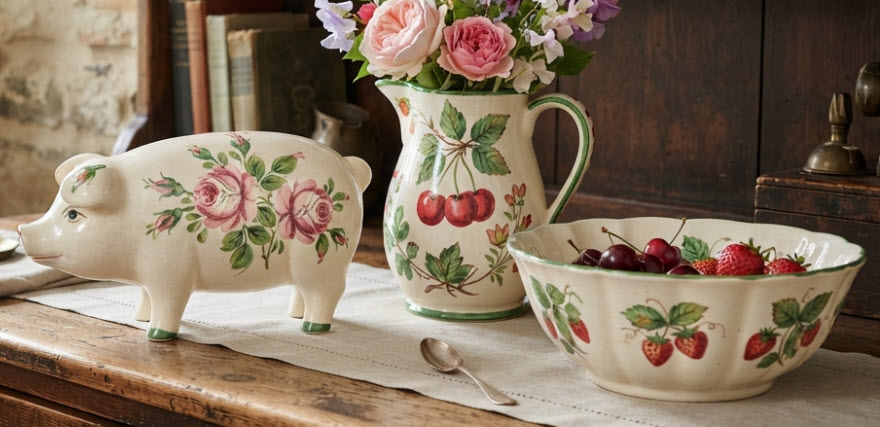
Wemyss Ware pottery is one of the most charming, distinctive, and characterful ceramic traditions to ever emerge from the British Isles. Instantly recognizable by its free-flowing, naturalistic hand-painted designs and quirky animal figures, it has captured the hearts of collectors for over a century.
If you are looking to put together a feature for your English collecting site, here is a comprehensive guide detailing its rich history, what makes it a joy to collect, and what the future holds for the market.
1. A Brief History: How Long Has It Been Going?
The story of Wemyss Ware spans well over 140 years, weaving its way through three distinct eras:
The Fife Pottery Era (1882–1930): The story began in Kirkcaldy, Scotland, when pottery owner Robert Heron partnered with a brilliant young Czech decorator named Karel Nekola, who brought continental flair and incredible hand-decoration skills. The ware was named “Wemyss” in honor of the local Wemyss family of Wemyss Castle, who were early and enthusiastic patrons. Distributed exclusively in England by the prestigious Mayfair retailer Thomas Goode & Co., it quickly found a home everywhere from country cottages to royal households (the Queen Mother was famously a devoted collector, amassing a massive private collection).
The Bovey Pottery Era (1930–1957): Due to the economic pressures of the Great Depression, the original Fife pottery closed in 1930. However, Karel’s son, Joseph Nekola, moved down to the Bovey Pottery in Devon, England, carrying on the tradition on a small scale and training apprentices like Esther Weeks. Production here finally ceased in 1957 following Joseph’s death and Esther taking over as head decorator.
The Griselda Hill Pottery Revival (1985–Present): After decades of dormancy, the tradition was triumphantly brought back to its spiritual home in Fife, Scotland, in 1985 by Griselda Hill. Esther Weeks even traveled to Fife to pass on the secret brush techniques directly to the new painters. Today, Griselda Hill Pottery continues to hand-paint exquisite traditional pieces, and legally owns the historic Wemyss Ware trademark.
2. Signature Styles and What Makes It So Unique
Wemyss Ware is celebrated for its vibrant, unpretentious aesthetic. If you spot a piece, look for these telltale characteristics:
Naturalistic Motifs: The pottery is heavily inspired by the British countryside, featuring hand-painted cabbage roses, thistles, fruit (apples, plums, and lemons), bees, poultry, and garden wildlife.
The Iconic Animals: Beyond tableware, Wemyss is world-famous for its ceramic cats (with their comical grins and glass eyes) and pigs (traditionally exchanged as New Year symbols of luck and abundance).
The “Bonjour” Pattern: Featuring bold black cockerels strutting across bright green grass, this is one of the most sought-after signature looks.
3. Is Wemyss Ware a Good Thing to Start Collecting?
An absolute yes. For anyone starting or expanding an English or Scottish antique collection, Wemyss Ware is a brilliant choice for several reasons:
Entry Points for Every Budget: While rare monumental pieces, large figural cats, or unique pigs can fetch tens of thousands of pounds at major auction houses (a pair of sleeping piglets once sold at Sotheby’s for nearly £70,000), smaller items like jam pots, small pin dishes, or modern Griselda Hill revival pieces remain far more accessible.
The Thrill of the Hunt: Because much of the early work was hand-painted by master artists (such as Karel Nekola or James Sharp), no two pieces are identical. Collectors can specialize by motif (e.g., only collecting cabbage roses or honey pots), by animal forms, or by seeking out specific decorator signatures.
Strong Market Stability: Unlike trendy consumer goods, antique Wemyss Ware has held its value remarkably well at fine art auctions. It possesses a dedicated, passionate collector base that ensures enduring demand.
4. What Does the Future Hold for Wemyss Ware?
The future of Wemyss collecting is remarkably bright, grounded in a healthy synergy between the antique market and active contemporary production:
The Antique Market Remains Robust: High-end pieces with great provenance, rare forms, or documented artist signatures continue to command intense interest from institutional buyers and private collectors alike. As fewer pristine antique pieces surface, prices for top-tier specimens are expected to remain firm.
A Living Tradition: Unlike many historical potteries that vanished completely into history books, the continuation of the craft via the Griselda Hill Pottery keeps the name alive in the public consciousness. This active continuation actually fuels interest in older pieces, as modern buyers often discover vintage Wemyss through contemporary exhibitions or National Trust properties (like Hill of Tarvit in Fife).