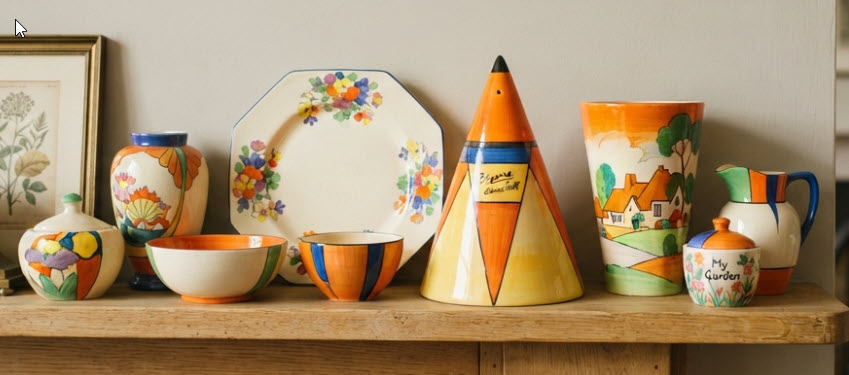
The Dazzling World of Clarice Cliff: A Collector’s Guide to Art Deco Pottery
If there is one name that defines the explosive, colourful energy of 1930s British ceramics, it is Clarice Cliff. Her revolutionary designs shattered the dull, traditional conventions of the Potteries in Stoke-on-Trent, replacing them with vibrant geometric patterns, striking art-deco shapes, and unashamedly bold colours.
For your English collecting site, here is a comprehensive dive into her life, the timeline of her work, current market values, and what the future holds for collectors.
1. The Woman Behind the Brush: Who Was Clarice Cliff?
Born on January 20, 1899, in Tunstall, Stoke-on-Trent, Clarice Cliff came from humble beginnings—her father worked at an iron foundry and her mother took in laundry to make ends meet.
At just 13 years old, Cliff entered the pottery industry as a gilder, painstakingly adding gold lines to traditional wares. Ambitious and talented, she moved around local factories to learn freehand painting and studied art and sculpture at the Burslem School of Art and later the Royal College of Art.
Her big break came when Colley Shorter, the owner of the AJ Wilkinson pottery factory (and later Newport Pottery), recognized her exceptional flair. He gave her her own dedicated studio space—a virtually unheard-of privilege for a young female designer at the time—allowing her to paint over older, flawed white earthenware stock to hide blemishes with bright, imaginative motifs. This happy accident birthed the legendary “Bizarre” range.
Cliff was a true pioneer: she was one of the first ceramic artists to stamp her own name and branding onto commercial pottery, transforming herself into a celebrity designer. Later in life, following the death of her first husband (her former boss, Colley Shorter), she quietly retired. She passed away in October 1972, just as the first major waves of renewed public interest and museum exhibitions were beginning to honor her legacy.
2. Timeline: When It Started and When It Finished
1913–1922 (The Apprenticeship Years): Clarice enters the industry at age 13, honing her skills in gilding, freehand painting, and modeling.
1927–1928 (The Birth of “Bizarre”): Following her studies and her move to Newport Pottery, her bold, hand-painted geometric patterns are test-marketed to an astounded public, sparking massive commercial success.
1930s (The Golden Era): The height of her creative output. She introduces iconic shapes like the Conical, Biarritz, Bonjour, and Lotus jugs, alongside famous landscape and abstract patterns like Crocus, Fantasque, Apples, and House & Bridge.
1939–1945 (World War II): Production shifts toward utility wares due to wartime restrictions and material shortages, drastically scaling back her vibrant artistic output.
1964 (Production Ends): Pottery bearing Clarice’s active name continues production under various corporate restructurings until the mid-1960s, after which Cliff officially steps away.
3. Is It Still Collected as Much Today?
Yes, absolutely. In fact, Clarice Cliff has achieved blue-chip status in the world of 20th-century ceramic collecting.
While the peak craze of the 1990s and her 1999 centenary saw astronomical market spikes, today’s collecting community has matured into a passionate, global network of dedicated enthusiasts. Specialty auction houses regularly host dedicated Clarice Cliff sales, and online collector groups span the globe. Pieces are prized not just as nostalgic home decor, but as significant milestones of Art Deco design history.
4. What Kinds of Prices Are Pieces Fetching?
The market value for Clarice Cliff varies enormously depending on the shape, the rarity of the pattern, and—crucially—the condition (hand-painted items are susceptible to minor paint flaking or hairline cracks).
Entry-Level (£30 – £150 / $40 – $200): Smaller pieces like saucers, toast racks, minor side plates, or common production runs of the perennial favorite Crocus pattern remain accessible.
Mid-Range (£200 – £800 / $250 – $1,000): Standard-sized geometric Bizarre plates, iconic conical sugar sifters, smaller coffee pots, and standard floral jugs or bowls comfortably fetch hundreds of pounds at regional UK auction houses and platforms like eBay.
High-End / Investment Pieces (£1,000 – £15,000+ / $1,300 – $20,000+): Rare architectural landscape patterns (like House & Bridge or Solitude), large Lotus jugs, and rare figural items (such as her famous Age of Jazz figures) routinely command thousands of pounds, with exceptional museum-grade masterworks pulling in massive bids at high-end fine art auctions.
5. The Future of Clarice Cliff Collecting
Looking ahead, the future for the market looks stable and bright, driven by a few key shifts:
A Younger Design-Conscious Audience: Mid-century modern and Art Deco aesthetics are having a continuous revival among younger homeowners looking to inject genuine personality and a splash of color into minimalist spaces.
Scarcity and Attrition: Because these are fragile, hand-painted earthenware items from nearly a century ago, pristine pieces are quietly disappearing into permanent collections or museums, naturally driving up the scarcity value of surviving examples.
Digital Communities: Dedicated websites, Instagram groups, and online auction platforms have made it easier than ever for novice collectors to authenticate pieces, swap knowledge, and source items from international markets.
Whether your site visitors are hunting for their very first budget-friendly Crocus saucer or tracking down a rare Fantasque tea set, Clarice Cliff’s legacy remains as vivid and irresistible today as it was in the roaring 1930s.