The Art of the English Glass Sealed Bottle (1650–1850)
Few antiques combine social history, craftsmanship, and tangible provenance quite like English glass seal bottles. Spanning two centuries from the Restoration to the early Victorian era, these heavy, dark-green glass vessels offer a fascinating window into English wine culture, tavern life, and aristocratic social status.
The Birth of the English ‘Black Glass’ Bottle
Before the mid-17th century, wine was transported in wooden casks and served at the table in ceramic jugs or fragile Venetian-style glassware. Bottles were thin, fragile, and far too costly for everyday storage.
In the 1630s, Sir Robert Mansell introduced coal-fired furnaces to English glassmaking. Burning coal generated significantly higher temperatures than traditional wood fires, allowing glassmakers to fuse iron-rich sand and lime into exceptionally thick, durable, dark green glass—commonly called “black glass”.
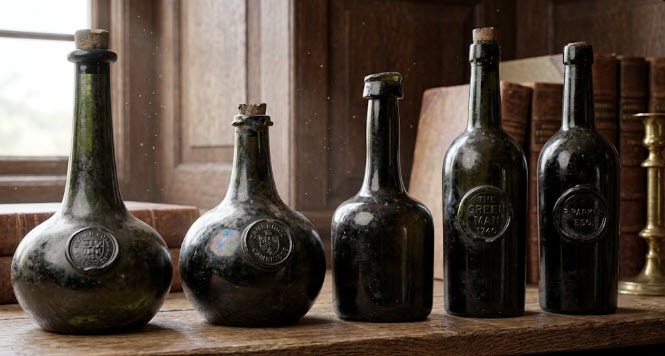
By the 1650s, English glassmakers began applying a small blob of molten glass onto the shoulder or body of the bottle, stamping it with a brass or iron die before it cooled. Thus, the sealed bottle was born.
Evolution of Bottle Shapes
Because early glass bottles were mouth-blown without rigid moulds, their silhouettes changed dramatically across the decades as glassblowing techniques evolved and functional needs changed.
| Period | Shape Profile | Key Characteristics |
|---|---|---|
| c. 1650–1680 | Shaft & Globe | Wide, bulbous body with a long, thin neck and deep Kick-up (base push-up). Highly prized by collectors. |
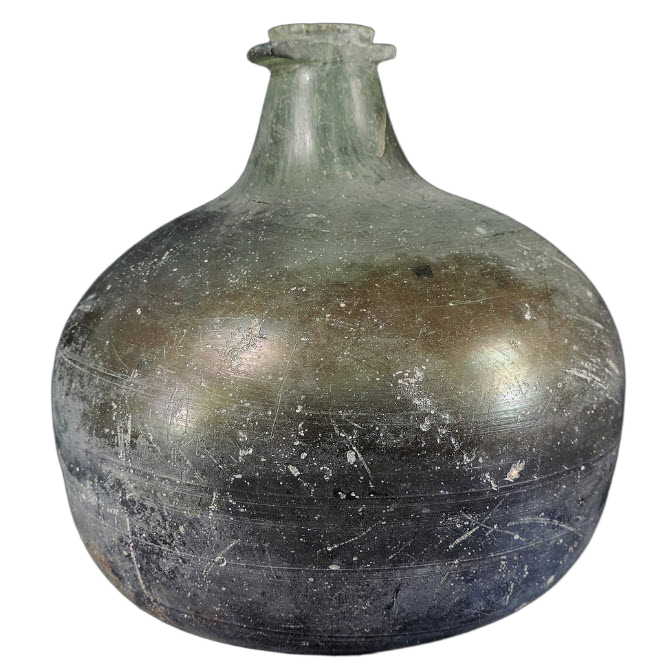
| c. 1680–1730 | Onion & Bladder | Squat, broad-based form designed for stability on tavern tables and ships. Shorter neck with a pronounced string rim. |
| c. 1730–1750 | Mallet | Straight, sloping sides narrowing toward the shoulder. Represents the transition towards binning bottles. |
| c. 1750–1850 | Cylindrical | Tall, uniform cylindrical profile. Allowed bottles to lie horizontally in cellar bins for long-term cork contact and wine ageing. |
What Do the Seals Tell Us?
A glass seal was the 17th- and 18th-century equivalent of a personal signature or brand mark. Because bottle manufacturing was expensive, sealed bottles were commissioned by wealthy individuals, institutions, or tavern owners.
The seals typically fall into four primary categories:
Gentleman’s Seals: Featuring coats of arms, crests, or full names (often accompanied by a date). These belonged to landed gentry, nobility, and wealthy merchants who bought wine in casks and had it bottled for their private cellars.
Tavern & Inn Seals: Incorporating tavern signs (e.g., The Crown, The Red Lion) alongside the landlord’s initials. These ensured customers received full measure and served as proof of ownership if stolen.
Oxford & Cambridge Colleges: High-table cellars at Oxbridge colleges routinely ordered custom-sealed bottles marked with college arms or crests (e.g., All Souls, Christ Church).
Merchant & Doctor Seals: Used by vintners, apothecaries, and cider producers to guarantee the authenticity and volume of their products.
Key Features for Collectors
When evaluating early English seal bottles, several physical details distinguish genuine period pieces:
The Seal Impression: Crispness and legibility add significant value. Sealed bottles account for only a small percentage of total 18th-century bottle production, making named and dated examples particularly sought after.
String Rims: The glass ring applied just below the lip. Used to anchor the wire or twine holding the cork in place against internal pressure.
Pontil Marks: A rough scar on the base where the glassmaker’s iron rod (pontil) was snapped off after finishing the neck.
Patination & Wear: Authentic age shows through subtle base wear, internal cellar staining, and iridescent surface decay (often resulting from centuries buried or kept in damp cellars).
Collecting & Valuation Guide
For the antique glass enthusiast, acquiring a genuine 17th- or 18th-century English sealed bottle is the pinnacle of early glass collecting. Because these bottles combine personal provenance, hand-blown craftsmanship, and historical rarity, market values vary significantly depending on key collectors’ metrics.
VALUATION DRIVERS
[ Age & Form ]
 Shaft & Globe vs Cylindrical
   [ Seal Details ]
[ Seal Details ]
 Full Names & Dates > Plain Initials
   [ Rarity/Crest ]
[ Rarity/Crest ]
 Noble Coats of Arms & Oxbridge
   [ Physical St. ]
[ Physical St. ]
Intact Lip Rims & Zero Star Cracks
Key Valuation Factors
When assessing the commercial and historical value of an English sealed bottle, specialist auctioneers and dealers evaluate five primary criteria:
Age and Form:
As a rule, the earlier the shape, the higher the value. 17th-century Shaft & Globe forms are exceedingly rare, while 19th-century cylindrical bottles are far more plentiful.
Seal Inscription:
Full Name & Date: The most desirable. A clearly legible 17th-century date adds substantial commercial value.
Coat of Arms / Armorial: Highly sought after by heraldry and regional history enthusiasts.
Taverns & Colleges: Oxbridge college seals command a strong, steady premium due to institutional collector demand.
Initials Only: The most common variety; generally forms the baseline price for any given shape.
Glass Quality & Color: Deep olive, rich forest green, or dark amber glass with heavy “seediness” (tiny trapped air bubbles) and an unpolished, crude finish attracts higher bids.
Condition: Check the string rim for chips or missing glass, inspect the body for “star cracks” (internal stress fractures), and ensure the seal itself is fully intact and distinctly stamped.
Iridescence & Patination: Bottles recovered from riverbeds (via mudlarking) or damp cellar vaults often carry a stunning, opalescent “peacock” patina. While natural patination is prized, severe “sick glass” (microscopic flaking decay) can weaken structural integrity.
Realised Price Ranges
| Bottle Style & Era | Typical Auction Valuation Range | Market Notes & Premium Factors |
19th-Century Cylindrical (c. 1800–1850) | £80 – £350 | Readily available. Price increases if stamped with a notable landed estate, merchant name, or precise date. |
Mid-18th-Century Mallet / Dumpling (c. 1730–1760) | £400 – £1,200 | Popular transitional shape. Clear armorial seals or Oxbridge crests comfortably reach the upper end of this range. |
Onion & Bladder Forms (c. 1680–1720) | £1,500 – £5,000+ | Highly sought after. Exceptionally rare dated examples or intact tavern seals can exceed £8,000+ at specialist sales. |
Shaft & Globe (c. 1650–1680) | £5,000 – £15,000+ | The holy grail of bottle collecting. Museum-grade examples featuring named early owners can command world-record prices at international auctions. |
Spotting Reproductions, Married Seals & Fakes
As values for early glass have climbed, fake and altered bottles have entered the market. Before purchasing, verify these indicators:
“Married” or Stuck-On Seals: Unscrupulous sellers sometimes take a loose, genuine glass seal dug from an archaeological site and attach it to an unsealed period bottle using modern epoxy or heated glass resin. Inspect the seal perimeter under ultraviolet (UV) light—fluorescence indicates modern adhesives. Examine where the seal joins the bottle; a genuine seal should show heat-fused flow lines seamlessly blending into the body.
Victorian & 20th-Century Replicas: In the late 19th and early 20th centuries, glasshouses produced decorative “onion” and “mallet” style bottles. These often feature uniform wall thickness, smooth machine-finished bases without true pontil scars, or artificial acid-etched patination that feels sticky or powdery to the touch.
Modern Molded Fakes: Genuine 17th- and 18th-century English sealed bottles were mouth-blown. Beware of any bottle featuring vertical mold seam lines running up the sides or through the glass seal—a telltale sign of modern reproduction.
Doubtful Dates: Be cautious of seals stamped with dates prior to 1650, as English glass bottle seals were not used before this decade.
Why Collect Them?
Free blown bottles, typically dating pre-1860, are collecting at its most personal. You are not just buying an antique; you are buying a frozen moment of human effort. The slight lopsidedness of a shoulder or the swirl of bubbles isn’t a defect—it’s the signature of the blower who made it.
Whether it’s a dark olive “black glass” utility bottle or a fragile apothecary phial, these vessels connect us directly to the artisan’s hand, making them the crown jewels of any bottle collection.