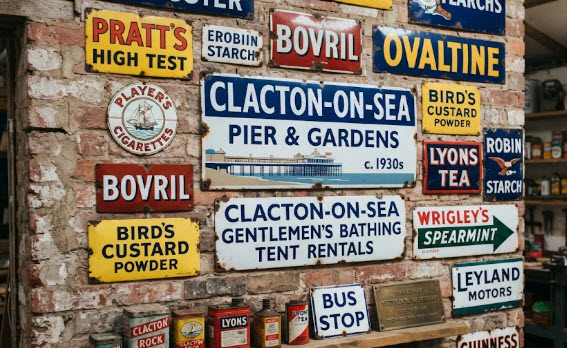
Introduction: How to Use This Book
The “Text-Only” Advantage
You are likely standing in a muddy field at a car boot sale, or huddled in the corner of an auction house. You don’t have time to load high-resolution images on a slow 4G connection. You need facts, prices, and identification tips—fast.
This book is written to be your “textual eye.” Instead of showing you a picture of a fake sign, I will tell you exactly what the rust feels like. Instead of a photo of a rare tea sign, I will describe the specific font quirk that doubles its value.
The Golden Rule of Picking
Before we start, memorize this rule: Condition is King, but Subject is Emperor.
A mint-condition sign for “Brown’s Bread” is worth £100.
A rusted, bullet-holed sign for “Fry’s Chocolate” might still be worth £500.
Always buy the brand that people love.
Chapter 1: The Grocer’s Shop (1930s Focus)
The village grocer was the canvas of the advertising world. In the 1930s, every spare inch of wall space was covered in enamel (vitreous) iron signs.
1. Tea & Coffee Signs
Tea signs are the most common entry point. They were produced in the millions.
Lyons Tea
The Standard Sign: Rectangular, usually 3ft x 1ft or larger.
Visual ID: The classic design is a white background with “LYONS TEA” in blue block text. The border is often a thin blue line.
The “Teashop” Variant: Look for signs that mention “J. Lyons & Co Ltd” in smaller script.
Value Guide (2024/25):
Standard Blue/White (Good Condition): £60 – £120
Pictorial (showing a waitress or tea cup – RARE): £500+
Orange & Blue variant (Art Deco style): £150 – £250
Brooke Bond Tea
The Standard Sign: Often orange/red and black.
Visual ID: Look for the slogan “Dividend Tea” or “Choicest.”
Value Guide:
“Dividend Tea” (Rectangle): £50 – £80
“Brooke Bond Tea” (Square, Red/Orange): £100 – £150
The Trojan Horse: Any sign featuring the “Trojan” van or specific early logos is worth £400+.
Mazawattee Tea
Visual ID: Almost always more ornate than Lyons. Look for gold lettering (often faded to brown) and dark backgrounds (black or deep blue).
Value Guide: Even in poor condition, these rarely drop below £200 because of their Victorian age. A mint example is £800+.
2. Soap & Laundry
These signs are often large and pictorial.
Sunlight Soap
The Standard Sign: “£1000 Reward!” This text is famous. It promises a reward if the soap contains impurities.
Visual ID: Often tri-colour: Red, Yellow, and Blue.
Value Guide:
Standard Text Only: £200 – £300
Pictorial (Woman hanging washing): £600 – £1,200
Bibby’s Soap
Visual ID: Look for the “Bibby Line” steamship references or the classic stork/bird logo.
Value Guide: £200 – £400 depending on size.
3. Chocolate & Confectionery
This is the “Blue Chip” investment area.
Fry’s Chocolate
The “Five Boys” Sign: This is the Holy Grail for many. It shows a boy’s face transitioning from “Desperation” (crying) to “Realization” (eating) to “Satisfaction” (smiling).
Visual ID: Five separate faces in a row.
Value Guide:
Original “Five Boys” (Enamel): £2,500 – £5,000+
Warning: Highly reproduced. See Chapter 6 for fake spotting.
Standard “Fry’s Chocolate” (Purple background, white text): £250 – £400
Cadbury’s
Visual ID: Deep, rich purple (Cadbury Purple) with white script.
Value Guide:
“Cadbury’s Cocoa” (Text only): £150 – £250
“Cadbury’s Dairy Milk” (Pre-war): £300 – £500
(Expansion Prompt: Add a section here on “Local Warwickshire Grocers”—list any specific local brands like ‘Kenilworth Jam’ or ‘Coventry Mineral Waters’ that might appear in your local sales.)
Chapter 2: The Garage & Motoring
Petroliana (petrol station collectibles) is currently the hottest sector in the UK market. The “Man Cave” factor drives prices up.
1. Enamel Signs (The Big Brands)
Shell
The Clam Shell: The shape is the key. A sign shaped like the shell logo is worth triple a square sign with the logo on it.
Visual ID: Yellow and Red. The 1930s signs often have “Shell Mex” or “Shell Motor Spirit” text.
Value Guide:
Square “Shell Motor Oil”: £400 – £600
Die-cut (Shell shaped) Hanging Sign: £1,500 – £3,000
“Shell Lubricating Oil” (Stickman figure – RARE): £2,000+
BP (British Petroleum)
Visual ID: The “Union Jack” shield. Before the green/yellow shield we know today, BP used a shield shape with the Union Jack flag pattern.
Value Guide:
BP Union Jack (1920s): £800 – £1,500
BP “Ethyl” (Square, Yellow/Green/Black): £300 – £500
Castrol
Visual ID: Green, White, and Red. The “Wakefield Castrol” text indicates pre-1960s age.
Value Guide:
“Wakefield Castrol” (Rectangular): £400 – £800
Round “Castrol” Thermometer signs (often missing the tube): £200 – £400
2. Oil Cans & Pourers
If you can’t afford the signs, buy the cans.
The “Pourer” (Conical Top)
These are the tall, cone-shaped pint or quart cans used to pour oil into engines.
Condition Check: Squeeze the can gently. If it crunches, it’s solid. If it feels soft/spongy, it has internal rust.
Value Guide:
Shell (Red/Yellow): £40 – £80
Castrol (Green/Red): £30 – £60
Esso (Blue/Red figure): £25 – £50
Rare Brands (Lodge, Cleveland, Russian Oil): £100+
The 2-Gallon Can (The Jerry Can predecessor)
Heavy steel cans with a brass screw cap.
Visual ID: The brand name is usually embossed (stamped) into the metal side.
Value Guide:
Common (Shell, Pratts): £15 – £30
Rare (Blue Bird, Redline, War Department marked): £50 – £150
The Brass Cap: The cap alone is worth £5-£10. Always check if the cap matches the can brand!
3. Glass Globes
These sat on top of the petrol pumps and lit up at night.
Visual ID: Made of opaque white glass (milk glass) with fired-on lettering.
Warning: This is the #1 faked item in motoring. A real globe feels “soft” and silky to the touch. A fake feels like cold, hard modern glass.
Value Guide:
Shell (Clam shape, glass): £500 – £800
BP (Shield shape, glass): £600 – £900
Plastic Globes (1960s/70s): £100 – £200
Bonus Section: The “Crown Jewels” – A Guide to Petrol Pump Globes
If enamel signs are the “street jewellery” of the collecting world, then Petrol Pump Globes are the Crown Jewels. These illuminated glass sculptures sat on top of pumps from the 1920s to the 1960s, glowing in the night to tell motorists which brand of fuel was being sold.
Because they were made of glass and sat exposed to the weather (and careless nozzle swings), survival rates are low. A pristine globe is often worth more than the petrol pump it sits on.
1. The Two Types of Globe
Before you buy, you must know what you are looking at. Globes come in two main structural forms:
Type A: The One-Piece (Glass)
Description: The entire globe is blown as a single piece of milk glass (opaque white glass). The lettering is fired directly onto the surface.
Feel: Smooth, seamless, and heavy.
Value: Generally higher because they are fragile and harder to reproduce convincingly.
Type B: The Two-Piece (Body & Lenses)
Description: A plastic or metal ring (the “body”) holds two separate circular glass discs (the “lenses”).
Context: These became common in the late 1940s and 50s.
Collector Note: The value is in the Glass Lenses. A plastic body is standard, but if the lenses are plastic (Perspex) instead of glass, the value drops by 80%.
2. The “Big Three” Makers (Check the Neck)
If you find a glass globe, turn it upside down and look at the “Neck” (the bottom rim that slots into the pump). On genuine British globes, you are looking for specific maker’s marks stamped or acid-etched into the glass.
Webb’s Crystal Glass: The Rolls-Royce of makers. Look for “Property of Shell-Mex and B.P. Ltd” or “Webb’s Crystal Glass made in England” stamped on the neck.
Hailware (Hailwood & Ackroyd): Based in Leeds. Their glass often has a slightly creamier, softer white tone than Webb’s.
Chance Brothers: Famous for lighthouse glass. Look for “Chance Bros” markings.
The “Neck” Rule:
Original: The neck is often rough, ground down, or shows “shear marks” from where the glass was cut while hot.
Fake: The neck is often perfectly smooth, shiny, and uniform.
3. The “Holy Trinity” of Shapes
While most globes are simple spheres or discs, three specific shapes command the highest prices.
1. The Shell “Clam”
Visual ID: The entire globe is shaped like the scallop shell logo.
The Colour: Genuine ones come in Red (rare), Yellow (common), and White (often milk glass).
The “Script” Test: Look at the word “Shell”. On early 1920s/30s globes, the letters are individually raised/embossed in the glass. On later ones, the surface is smooth with the text painted on.
Price Guide (2025):
Red Glass Clam: £2,000 – £4,000
Yellow/White Glass Clam: £600 – £1,200
Plastic Reproduction: £50 – £80
2. The BP “Shield”
Visual ID: A fully 3D glass shield (not just a picture of a shield on a round globe).
The Detail: The green and yellow paint should be “fired on” (fused to the glass). If you can scratch the paint off with a fingernail, it’s either a fake or a very late/cheap version.
Price Guide: £800 – £1,500 for a damage-free example.
3. National Benzole “Mr. Mercury”
Visual ID: A white globe featuring the head of the god Mercury (winged helmet).
The “Head” Globe: There is an incredibly rare version where the entire globe is shaped like Mercury’s head. This is a museum piece worth £5,000+.
The Standard Globe: A square-ish white globe with a picture of Mr. Mercury.
Price Guide: £800 – £1,200 (Recent auction result: £1,450 at H.J. Pugh, Oct 2024).
4. How to Spot a Fake (Text-Only Checklist)
The market is flooded with reproductions. Use this checklist in the field.
Test 1: The “Decal” Test
Fake: The image (e.g., the Red Horse of Mobil) is a water-slide transfer (decal) applied to the surface. If you run your finger over the edge of the image, you can feel a distinct “step” or ridge where the sticker ends.
Real: The image is screen-printed and fired into the glass. It feels smooth or like a very subtle layer of paint, not a plastic sticker.
Test 2: The “Date Stamp” Trick
Fake: Many fakes have a date stamped on the neck (e.g., “1938”) to fool you.
The Tell: Fake date stamps are often crisp, perfectly uniform, and look like they were typed yesterday. Genuine stamps are often faint, wonky, or partially worn away.
Test 3: The “Cold” Glass
Real: Old “Milk Glass” feels soft, almost silky or waxy to the touch.
Fake: Modern glass feels cold, hard, and “brittle.” It lacks the soft translucency of the antique material.
5. Price Hierarchy (2024/25 Market)
Tier 1: The Common (Value: £150 – £300)
Standard “Brand Name” globes (e.g., “Esso”, “Cleveland”, “Fina”) on a round white body.
Condition: Fading to lettering is common.
Tier 2: The Desirable (Value: £400 – £800)
Globes with Pictorial Logos (e.g., The Power “Gloves”, The Dominion “Crown”).
Pre-War “Ethyl” globes (The word “Ethyl” usually indicates 1930s/40s).
Tier 3: The Unicorns (Value: £1,000+)
“Power” Petrol: Look for the globe shaped like a hand holding a lightning bolt.
“Dominion”: Look for the globe shaped like a cluster of grapes (very rare).
“Aviation” Spirit: Any globe marked “Aviation” or “Aero” is instantly high-value due to the connection with early flight.
Chapter 3: The Railway Station
Railwayana is a cult market. It is dominated by one specific item: The Totem.
1. The “Totem” Station Sign
These are the sausage-shaped signs (“half-round”) that sat on lamp posts on platforms, displaying the station name.
Visual ID: Enamel, flanged edges, approx. 36 inches long.
Colour Code (CRITICAL): The colour tells you the region, and the region dictates the price.
Maroon: London Midland Region (LMR). Common.
Tangerine (Orange): North Eastern Region (NER). Highly Desirable.
Green: Southern Region (SR). Popular.
Dark Blue: Eastern Region (ER). Standard.
Chocolate & Cream: Western Region (WR). Very Popular.
Light Blue: Scottish Region (ScR). Rare.
Value Guide (The Hierarchy)
Closed Stations: If the station was closed by Beeching in the 1960s, the sign is worth double. (e.g., “Grantown-on-Spey” = £2,000+)
Holiday Destinations: Seaside towns (St Ives, Torquay) command a premium. (£1,500+)
Standard Mainline: Common commuter stations (e.g., Watford Junction). (£300 – £500)
2. Directional & Informational Signs
If you can’t find a Totem, look for the functional signs.
“Way Out”: The classic exit sign.
Value: £150 – £250
“Ladies Room” / “Gentlemen”:
Value: £100 – £200
“Beware of Trains”:
Value: £300+ (Danger signs always sell well).
3. Carriage Prints
These are the rectangular landscape pictures that sat above the seats in old carriages.
Visual ID: printed on card, usually measuring 20″ x 10″.
Hamilton Ellis: Famous artist who painted steam trains. His prints are worth £30 – £50.
Landscape Views: Worth £20 – £40.
Condition: Watch out for water stains in the corners.
Chapter 4: The Farm & Agriculture
Often overlooked, farming signs are “sleepers” in the market. They are rustic, often pictorial, and fit well in country kitchens.
1. Animal Feed & Medicine
Spratts (Dog & Chicken Food)
Visual ID: Usually orange background with black text.
The “Chikko” Sign: “Spratts Chikko for Chicks”.
Value Guide: £300 – £500
Thorley’s Food (Cattle)
Visual ID: Often features a prize pig or cow.
Value Guide:
Text only: £100
Pictorial (Prize Pig): £800 – £1,200 (Very Rare)
Blue Cross Tea
Historically sold to farmers’ wives.
Value Guide: Blue and white signs, often found in poor condition. Good condition: £150.
2. Machinery Signs
These were attached to barns or dealerships.
Ransomes (Ploughs & Engines)
Visual ID: “Ransomes, Sims & Jefferies”. Usually yellow/orange text on blue.
Value Guide: £200 – £400.
The “Lawnmower” Sign: Ransomes invented the mower. Any sign depicting a mower is £500+.
Lister (Engines & Separators)
Visual ID: “Lister Cream Separators”.
Value Guide: Scroll-shaped signs or pictorials: £150 – £250.
3. Implement Seats
Cast iron seats from tractors or horse-drawn ploughs.
Visual ID: Shaped like a buttocks, often with pierced holes and the maker’s name cast in (e.g., “Blackstone”, “Bamford”).
Value Guide:
Common (Martin, Blackstone): £30 – £50
Rare (Walter A. Wood, ornate lattice patterns): £100 – £150
Fake Alert: If it is painted in bright, fresh colours, it’s likely a modern reproduction. Real ones are usually rusty or painted in dull, oily farm paint.
Chapter 5: Condition Grading by Text
Since you cannot see the item, you must learn to grade it by description. Use the “Clock Face” method when noting defects.
The “Mint” Myth
True Mint (10/10): Looks like it was made yesterday. Glossy, zero chips. (Almost impossible for pre-1950 items).
Near Mint (9/10): High gloss. Maybe one tiny chip (less than 5mm) on the screw hole (flange), not the image.
Excellent (8/10): Good gloss. Chips restricted to the edges/border. The main text/image is clean.
Very Good (7/10): Displayable. Maybe one chip in the “field” (the main image area) but it doesn’t obscure a letter or face.
Good/Average (5-6/10): Significant chips. Rust bleed (staining). “Bullet holes” (common on farm signs). The sign is readable but tired.
Poor/Relic (1-4/10): Heavy rust. Metal is thin or perforated. Only buy if it is extremely rare (e.g., a Titanic ticket office sign).
The Restoration Check
Run your finger over the chips.
Real Damage: Feels sharp, jagged, and drops down to the metal.
Restored: Feels smooth, waxy, or warm (plastic filler). If you shine a UV torch (blacklight) on it, restoration will glow purple/white.
Chapter 6: The “Text-Only” Fakes Guide
This is the most important chapter. If you memorize this, you will save thousands of pounds.
1. The “Laser” Reflection Test (For Mirrors)
How to do it: Place the tip of a coin or your fingernail against the glass surface of the mirror.
Real Antique Mirror: You will see a gap between your fingernail and its reflection. This is because the image is on the back of the thick glass.
Fake Mirror: Your fingernail touches its reflection directly. This means the image is printed on the front surface.
2. The “Orange Rust” Rule (For Enamel Signs)
Real Age: Iron oxidizes to a dark brown/black colour over 50 years. It looks like dried blood or dark chocolate. It is hard and stained into the metal.
Fake Age: Fakers use acid to rust new steel quickly. The result is a bright, powdery Orange rust. If the rust looks like Cheeto dust, walk away.
3. The “Dribble” Test
Action: Turn the sign over and look at the back.
Real Sign: The back is usually coated in a rough, speckled enamel (often grey, dark blue, or black). It looks like “orange peel” paint. It is messy.
Fake Sign: The back is often smooth, clean black paint, or raw steel.
Note: Genuine signs were dipped or heavily coated. You should see “dribbles” or thick pooling of enamel in the corners of the back. Fakes are spray-painted and too neat.
4. The “Stubby” Michelin Man
There is a flood of fake Michelin signs.
The Tell: Look at Bibendum (the Michelin Man). On fakes, his proportions are wrong. He often looks “squashed” or “stubby,” and his eyes are often just black dots without detail. On real signs, the artwork is crisp, and he is usually smoking a cigar (on pre-war signs) or running.
5. The “Flat” Sign
Real: Most pre-1940 signs have a slight “camber” or curve to the metal plate (shelving) to add strength. The mounting holes often have grommets (brass rings).
Fake: The metal is perfectly flat and thin. It flexes easily if you twist it. Real enamel signs are rigid.
Chapter 7: Quick Reference Price Brackets (2025 Market)
Use this quick-list when scrolling fast.
Under £50 (The Bargain Bin)
Plain text “No Smoking” enamel signs.
Small “Warning” or “High Voltage” signs.
Common 1970s tin signs (Coca-Cola reproductions).
Rusty 2-gallon petrol cans (no cap).
Common paper trade cards.
£50 – £150 (The Bread & Butter)
Lyons Tea (Blue/White rectangle).
Brooke Bond Tea (Red/Black).
Castrol Oil pourers (pint size).
Implement seats (Common cast iron).
Wills/Players Cigarette tin signs.
£150 – £500 (The Collector’s Standard)
Most 1930s pictorial Grocer signs (Soap, starch, polish).
Railway “Way Out” and directional signs.
Common Railway Totems (Maroon/LMR).
Shell/BP square enamel signs.
Good condition farming pictorials (Spratts).
£500 – £1,500 (The High End)
Pictorial Tea signs (Maids, cups).
Rare Railway Totems (Orange/Green/Blue).
Mint condition Motoring signs (Union Jack BP).
Glass Petrol Globes (Original).
£2,000+ (The Investment Grade)
Fry’s “Five Boys” Enamel (Original).
Scottish/West Country closed line Totems.
Die-cut (shaped) motoring signs (The Shell Clam).
Unique/One-off local brewery signs.
Conclusion: The Hunt
You are now armed with the knowledge to spot a gem in a pile of rust. Remember, the market fluctuates, but quality always sells. Use this guide to verify the brand, check the rust colour, and ensure you aren’t paying “Pictorial” prices for “Text Only” items.
Keep this ebook on your home screen. The next time you see a flash of blue and white enamel under a table at a car boot sale, you’ll know if it’s a £20 reproduction or a £200 Lyons Tea sign.