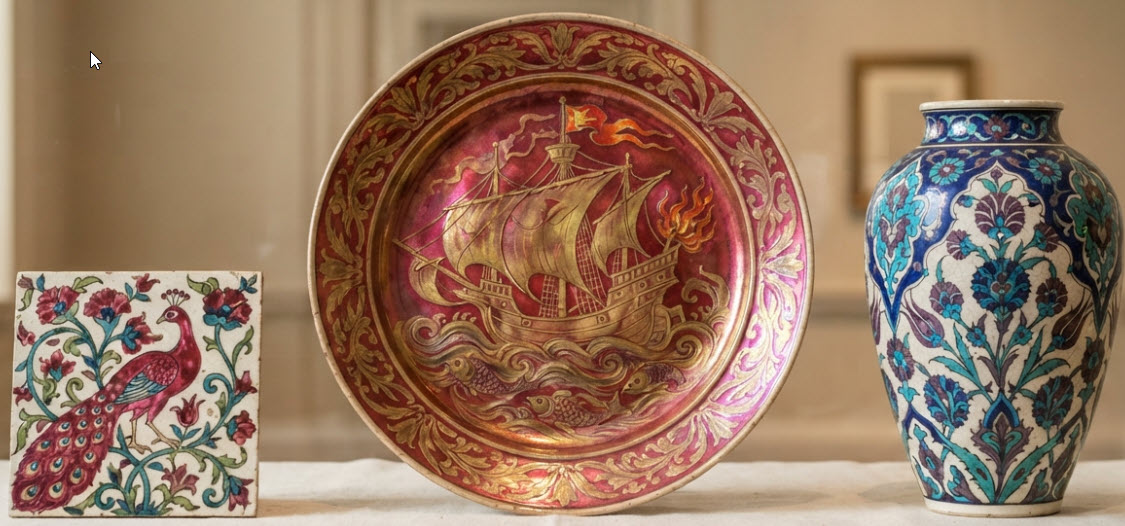
William Frend De Morgan was far more than just a talented Victorian craftsman—he was a eccentric, brilliant visionary who bridged the worlds of high art, industrial chemistry, and whimsical fantasy. As a central figure of the Arts and Crafts movement, De Morgan revolutionized ceramic design through his obsession with Islamic glazes and mythical creatures.
1. Timeline: When Did He Work and When Did He Close?
De Morgan’s career as a professional potter spanned roughly 34 years, divided into distinct phases across London:
1872–1882 (Chelsea Period): De Morgan began experimenting with kilns and pottery in earnest around 1872 in Chelsea, initially decorating commercially manufactured blank tiles (often from Wedgwood or the Architectural Pottery Co.).
1882–1888 (Merton Abbey Period): Seeking a larger space close to his close friend and collaborator William Morris, De Morgan moved his workshop to Merton Abbey near Wimbledon. Here, they playfully referred to their adjacent factories as “the fictionary” because they could hardly believe they had moved to the country. This era marked his transition into manufacturing his own pots from scratch.
1888–1907 (Fulham Period): Due to health issues and the grueling daily commute from Chelsea, De Morgan moved his operations back to West London (Sands End, Fulham). The Fulham period is widely considered his most ambitious and artistically sophisticated era, producing stunning multi-lustre vases, plates, and large tile panels.
The Closure (1907): By the turn of the century, changing Victorian and Edwardian tastes meant that ornate Arts and Crafts wares were falling out of fashion. Battling financial struggles and declining health, De Morgan officially closed the pottery in 1907 (though the Passenger brothers, his master painters, lingered on briefly until around 1910). Famously lamenting the shift in tastes, De Morgan remarked:
“All my life I have been trying to make beautiful things… and now that I can, nobody wants them.”
Following his pottery closure, De Morgan reinvented himself yet again—becoming a wildly successful and bestselling novelist in his twilight years before passing away in 1917.
2. The Unique Artistry of De Morgan Pottery & Tiles
De Morgan’s work is instantly recognizable due to a few signature elements:
The Magic of Lustreware: De Morgan became obsessed with recreating the shimmering, iridescent metallic glazes (ruby, gold, and copper hues) found on ancient Islamic pottery. He spent decades perfecting his chemical formulas to achieve a brilliant, rainbow-like sheen that shifts in the light.
Whimsical Fauna & Flora: Drawing inspiration from Middle Eastern Iznik designs, Persian motifs, and nonsense literature (like Lewis Carroll’s The Snark), his tiles and panels feature prancing dodos, fierce tigers, galleons under full sail, intertwined serpents, and stylized carnations.
The “BBB” Pattern: One of his most ubiquitous and commercially successful tile designs was the BBB pattern (named after Barnard, Bishop and Barnard, a Norwich cast-iron fireplace manufacturer for whom he designed fireplace surrounds).
3. How Valuable Are They and How Is The Market?
The market for William De Morgan pottery and tiles is robust, highly active, and fiercely competitive among collectors of Victorian and Arts and Crafts design.
Individual Tiles: Standard single 6-inch tiles (such as floral or common animal motifs painted on commercial blanks) typically command anywhere from £300 to over £1,500 at auction depending on condition and rarity. Rare triple-lustre or pictorial tiles featuring unique animals can push past £4,000 per tile.
Vases and Hollowware: Major Fulham-period vases and chargers frequently realize prices ranging from £8,000 to £20,000+, with exceptional museum-grade pieces occasionally achieving even higher figures globally.
Major Tile Panels: Large multi-tile narrative panels (such as galleons or peacocks) are treated like fine paintings. For instance, rare large panels can fetch anywhere from £5,000 to upwards of £65,000 at specialized design auctions.
Is the market good? Yes. Because De Morgan produced a finite amount of handmade art before closing his doors in 1907, supply is strictly limited. While general economic shifts can cause minor dips, premier pieces with strong provenance consistently outperform estimates at major auction houses (like Lyon & Turnbull, Cheffins, and Fieldings), driven by institutional interest and dedicated private collectors.
4. More About the Man: An Unusual Polymath
William De Morgan was a man of extraordinary contradictions and intellectual depth:
Scientific Tinkerer: De Morgan didn’t just design; he engineered. He spent countless hours in his back garden risking life and limb with makeshift kilns, experimenting with toxic metallic oxides, kiln temperatures, and oxygen reduction techniques to get his lusters right. (One famous early experiment resulted in a fire that burned down part of his family home!)
A Political Progressive: De Morgan was deeply principled. Long before it was mainstream among Victorian men, he was an ardent feminist and served as the vice-president of the Men’s League for Women’s Suffrage in 1913.
The Artist Couple: He was married to Evelyn De Morgan, one of the most brilliant Pre-Raphaelite/Symbolist painters of the era. Their marriage was a legendary intellectual and artistic partnership. Upon his death in 1917, Evelyn preserved his legacy by bequeathing hundreds of his original design drawings to the Victoria and Albert (V&A) Museum