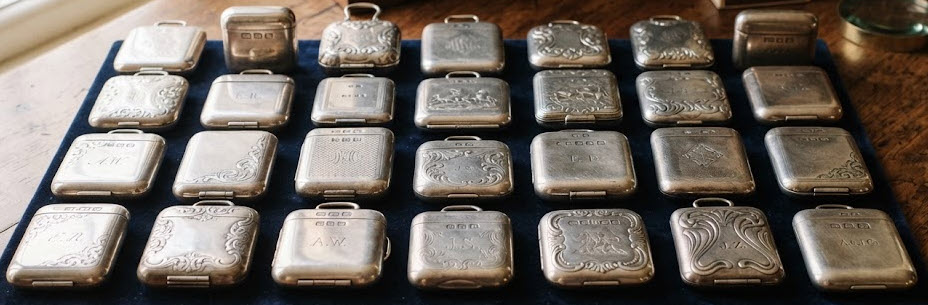
Pocket-Sized History: The Art of Collecting English Vesta Cases
Few antiques pack as much history, social context, and sheer craftsmanship into the palm of your hand as an English vesta case. Popularized during the Victorian and Edwardian eras, these miniature metal boxes were essential everyday accessories. Today, they represent one of the most accessible, diverse, and rewarding fields for the antique collector.
1. What Exactly is a Vesta Case?
Known as “match safes” in the United States, a vesta case is a small, pocket-sized container designed to hold friction matches and keep them safe from moisture.
The name comes from Vesta, the Roman goddess of the hearth and home. In 1832, inventor William Newton patented the “wax vesta”—a short match made with a wax stem and a highly volatile, sulphur-tipped head. Because early matches were prone to spontaneous ignition from friction or dampness, carrying them loose in a pocket was a hazardous gamble. The vesta case solved this safety crisis.
Typically featuring a spring-loaded flip-top lid to prevent accidental opening and a serrated or ribbed striking strip integrated into the bottom base, these cases were indispensable items. Whether a gentleman was lighting a cigar or a lady was lighting a parlor candle, the vesta case was pulled out dozens of times a day.
2. A Mirror to Society: Types and Styles
Because everyone from working-class laborers to the social elite used matches, vesta cases were manufactured across a massive spectrum of materials and designs:
-
Everyday & Promotional Pieces: The working public carried cases made of brass, tin, gunmetal, or vulcanite. Many served as early marketing tools, stamped with advertisements for tea, tobacco, or local businesses.
-
Engine-Turned Sterling Silver: The most common luxury versions feature geometric, machine-engraved patterns (engine-turning). While handsome, their abundance means they are generally modest in value, judged primarily on their weight, date, and maker.
-
Pictorial and Engraved Cases: Many cases were hand-engraved with hunting scenes, sporting motifs (like golf, fishing, or shooting), foliage, or family crests.
-
Enamelled Masterpieces: Highly coveted by advanced collectors, these feature colorful painted enamel panels depicting landscapes, sporting events, or whimsical (and sometimes risqué) subjects.
-
Novelty and Figural Cases: The holy grail for many collectors. Master silversmiths molded these cases into extraordinary shapes—such as animals (pigs, owls, foxes), jockeys’ boots, skulls, books, or sentry boxes with tiny sliding soldiers.
-
Combo-Cases (Dual-Purpose): To maximize utility, some vestas doubled as stamp boxes, sovereign holders, or incorporated fold-out cigar cutters and pocket knives.
3. Notable Makers and British Hallmarks
The golden age of the vesta case ran roughly from the 1860s to the 1920s, before the rise of reliable petrol lighters rendered them obsolete.
The vast majority of fine English sterling silver vesta cases were crafted and assayed in Birmingham, though London and Chester also produced significant numbers. When examining a British silver vesta, look inside the rim or on the lid for a full set of hallmarks:
-
The Lion Passant: Denotes sterling silver standard.
-
The Assay Office Mark: An anchor for Birmingham, a leopard’s head for London, or three sheaves for Chester.
-
The Date Letter: Pinpoints the exact year of assay.
-
The Maker’s Mark: The initials of the silversmith.
Keep an eye out for legendary specialty makers such as Sampson Mordan & Co. (famous for ingenious novelty designs), Deakin & Francis, George Unite, and A & J Zimmerman.
4. Tips for Starting Your Collection
-
Start Accessible: You don’t need a fortune to begin. A charming, plain Edwardian or late-Victorian silver vesta can often be found at a local antique market or reputable dealer for a modest entry price.
-
Condition is Everything: The antique market is harsh on damaged pieces. Check the hinge and spring—the lid should snap shut tightly with a crisp click. Look out for heavy dents on the corners, splits along the side seams, or worn-away engine turning.
-
Beware of Fake Enamels: Because enamelled and novelty vestas command high prices, forgers occasionally take a cheap, plain vintage silver vesta and retroactively paint or enamel sporting or risque scenes onto it. Buy from trusted specialists who guarantee their inventory.
-
Watch the Ring Loop: Most pocket vestas originally featured a small ring loop at the bottom or side so they could dangle gracefully from an Albert watch chain or fob. Check if this loop is intact, as its removal can detract from collector value.
Whether you decide to focus purely on whimsical animal novelties, crisp Victorian engraving, or historical silver hallmarks, collecting vesta cases offers a tangible link to an elegant, bygone era of pocket-sized luxury.