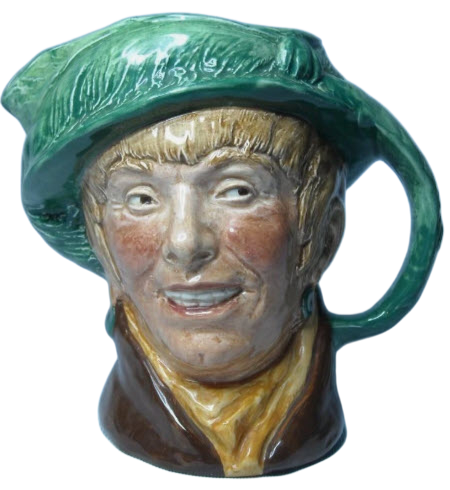


Faces of History: A Guide to Collecting Royal Doulton Character Jugs
For many of us who frequent antique fairs or browse the “pottery and porcelain” sections of eBay, the sight is instantly recognisable: a shelf of faces staring back at you. Some are jovial, some grumpy, but all are distinctly British. These are the Royal Doulton Character Jugs, and for nearly a century, they have been one of the most accessible and enjoyable entry points into English ceramics.
Toby vs. Character: Knowing the Difference
The first lesson for any new collector is the distinction between a “Toby” and a “Character” jug. The traditional Toby jug—named after the legendary drinker Toby Fillpot—depicts a full-bodied figure, usually seated with a jug of ale and a pipe.
Royal Doulton changed the game in 1934 when Art Director Charles Noke introduced a new style: the Character Jug. These pieces dispensed with the body entirely, focusing solely on the head and shoulders. The first two to be released, John Barleycorn and Old Charley, set a standard that would last for decades. By focusing on the face, Doulton’s modellers could inject far more personality and detail into the moulding, capturing the wrinkles of a smile or the grimace of a pirate.
Sizes and Variations
One of the joys of this collection is that it can fit almost any space. Doulton typically produced these jugs in four main sizes, though the terminology can be tricky for beginners:
Large (approx. 6–7 inches): The standard shelf-sitter.
Small (approx. 3–4 inches): Perfect for mantelpieces.
Miniature (approx. 2 inches): Often sold as souvenirs.
Tiny (approx. 1.5 inches): The smallest and fiddliest to find.
The Handles Tell a Story
As you look closer, pay attention to the handles. In the early days (1930s–40s), handles were simple loops. However, as production moved into the 1950s, the handles became part of the story. A Long John Silver jug isn’t just a pirate’s face; the handle is formed by his parrot. A Falstaff might have a handle shaped like a flagons of ale. These “derivative handles” are often what separates a good piece from a great one in terms of display appeal.
What to Look For
While prices for common jugs have settled—you can often pick up excellent examples for £20 to £40—rarity is king. Look for “prototypes” or colour variations that shouldn’t exist. For instance, the infamous “white” or undecorated jugs are often tests that escaped the factory.
Always check the backstamp. A standard lion-and-crown mark is safe, but look for the small “A” mark (used roughly 1939–1955) to date your piece to the golden mid-century era. And, as always with pottery, check the high points—noses and hat rims—for those tiny, value-killing chips.
Whether you are hunting for a Winston Churchill to complete a war memorabilia collection or just love the grumpy face of a Sairey Gamp, these jugs remain a wonderful slice of British social history—affordable, colourful, and full of character.