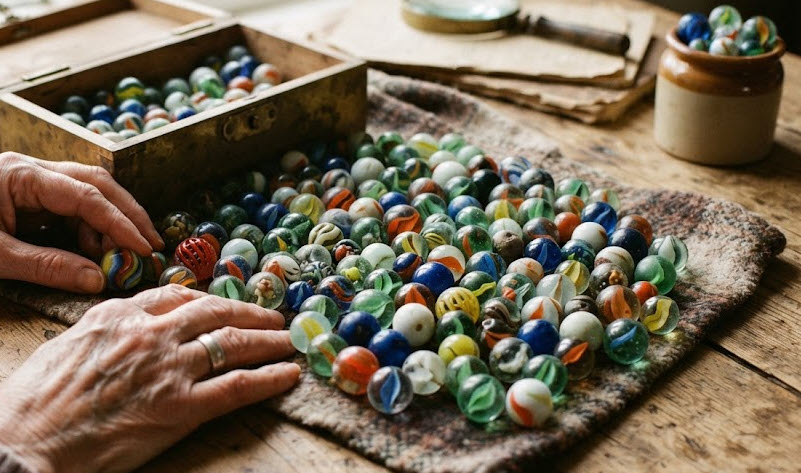
The Spherical World: A Guide to Collecting Rare and Unusual Marbles
For many, the word “marble” instantly brings back childhood memories—skidding glass spheres across a dusty playground, trading “peewees” and “steels”, or carefully lining up a prized shooter. But beyond the simple playground game lies a rich, centuries-old world of art, history, and obsession.
Collecting rare and unusual marbles is a fascinating hobby that blends antique craftsmanship with modern artistry. Far from being mere children’s toys, vintage and handmade marbles are miniature masterpieces of molten glass.
A Brief History of Glass Spheres
While humans have played games with spherical objects for millennia using clay, stone, and marble (the rock), glass marbles as we know them gained prominence in the 19th century.
The German Hand-Made Era (approx. 1840s–1914): Before mass production, master glassblowers in Germany used specialised shears and canes of coloured glass to craft stunning works of art by hand. These include the famous Latticinio (net-like white threads) and Swirls with colourful cores.
The American Machine-Made Boom: When the First World War halted German imports, American inventors revolutionised the craft. Pioneers like M.F. Christensen and the Akro Agate Company introduced automated machines, giving birth to iconic styles like Patches, Ribbons, and Slags.
The Holy Grails: What Makes a Marble Rare?
Not all marbles are created equal. If you are starting a collection or hunting through antique shops, here are the categories and features that make collectors’ hearts race:
1. Hand-Made German Swirls
Because every single one was crafted by hand, no two German swirls are identical. Collectors look for rare core colours (such as rare shades of pink or multi-coloured ribbon cores) and complex outer latticinio networks. A flawless, large hand-made swirl can command thousands of pounds.
2. Sulphides
Imagine looking inside a clear glass marble and finding a tiny, perfectly detailed white figurine—an animal, a person, or an object. These are sulphides, made in Germany during the 19th century by embedding a small ceramic-like figure (made of metallic sulphide) into molten glass. Popular subjects include lions, dogs, birds, and historical figures.
3. Lutz Marbles
Named after the distinct golden or copper aventurine glass flakes (“Lutz”) used in their creation, these hand-made marbles sparkle brilliantly from the inside when caught in the light. They are exceptionally rare and highly sought after.
4. Contemporary Art Marbles
The marble world isn’t just about antiques. Over the last few decades, studio glass artists have pushed the boundaries of what a marble can be. Modern art marbles often feature intricate implosion techniques, mesmerising 3D jellyfish, swirling galaxies, and hyper-detailed botanical patterns trapped forever in glass.
Tips for Beginning Marble Collectors
If you are eager to start your own collection, you don’t need to dive in with expensive antiques. Here is how to begin your journey:
Invest in a UV Blacklight: Many vintage marbles—especially those made by British or American manufacturers, or certain Vaseline glass varieties—glow brilliantly under ultraviolet light. It is an essential tool for authenticating and discovering hidden gems.
Learn the Terminology: Familiarise yourself with terms like pontil mark (the rough spot where the marble was snapped off the glass cane), cortex, and core.
Start Small: Flea markets, antique centres, and car boot sales are wonderful places to find mixed jars of vintage machine-made marbles. Sorting through them to find a hidden treasure is half the fun.
Protect Your Treasures: Because glass marbles can chip or scratch each other, collectors use specialised display stands, wooden trays with individual indentations, or padded boxes to keep their pieces safe.
Whether you are drawn to the historical mystique of a 19th-century German swirl or the mind-boggling artistry of a modern glass sculpture, collecting marbles offers a wonderful window into miniature craftsmanship.
Would you like to explore some advice on how to tell a hand-made marble apart from a machine-made one, Terry?