The Breath of the Artisan:
Collecting Free Blown Bottles
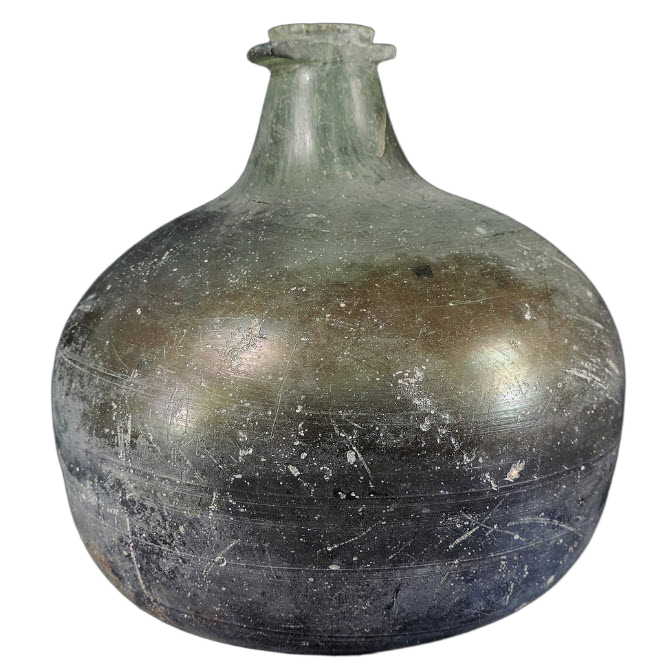
For the serious collector, few items hold the same romance as a “free blown” bottle. Unlike their machine-made successors that rolled off assembly lines by the millions, every free blown bottle is a solitary survivor—a unique testament to the lung power and steady hand of a craftsman from centuries past.
What is Free Blown Glass?
Before the mid-19th century, this was the primary method of bottle production. A glassblower would gather a molten “glob” of glass on the end of a blowpipe and inflate it with his own breath. Without the constraints of a mold, the bottle was shaped entirely by gravity, centrifugal force, and hand tools (paddles and shears).
Identification: Reading the Glass
Identifying these pieces requires looking for what isn’t there as much as what is.
-
The Missing Seam: The most dead giveaway is the absence of mold seams. Run your finger along the side of the bottle; if it is perfectly smooth from base to lip, you are likely holding a free blown piece.
-
The Pontil Scar: Check the base. Because the bottle had to be held while the neck was finished, a rod (pontil) was fused to the bottom. When snapped off, it left a rough scar or “belly button.” While later bottles have smooth bases, a true early free blown bottle will often wear this scar proudly.
-
Beautiful Imperfections: Look for asymmetry. A slightly leaning neck, a body that isn’t perfectly round, or “seeds” (tiny bubbles) trapped in the glass are hallmarks of the manual process.
Why Collect Them?
Free blown bottles, typically dating pre-1860, are collecting at its most personal. You are not just buying an antique; you are buying a frozen moment of human effort. The slight lopsidedness of a shoulder or the swirl of bubbles isn’t a defect—it’s the signature of the blower who made it.
Whether it’s a dark olive “black glass” utility bottle or a fragile apothecary phial, these vessels connect us directly to the artisan’s hand, making them the crown jewels of any bottle collection.