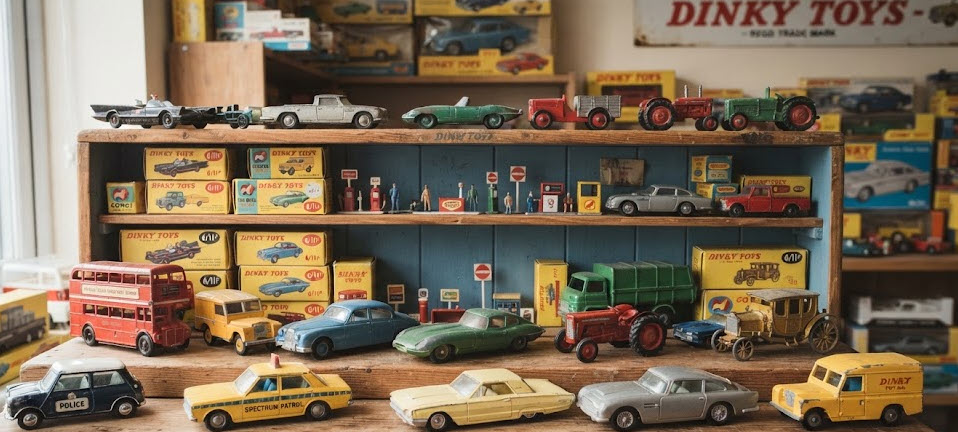
Small Scale, Big Nostalgia: The Enduring Charm and Future of Dinky and Die-Cast Collecting in the UK
There is a distinct, unmistakable sound that resonates with generations of British collectors: the sharp flick of a cardboard box flap, the rustle of tissue paper, and the heavy, reassuring clink of zamak metal meeting a wooden shelf.
For nearly a century, die-cast model vehicles—led titanically by Dinky Toys—have occupied a cherished place in British culture. What began as humble metal accessories for Hornby model railways grew into a national passion, shaping how children imagined the world and establishing a sophisticated hobby that remains as vibrant today as it was decades ago.
1. The History: From “Modelled Miniatures” to British Icons
The story of British die-cast collecting is inextricably linked to Meccano Ltd of Liverpool. In December 1933 (with branding shifting to Dinky Toys by April 1934), Frank Hornby’s empire released a series of tiny metal vehicles designed to populate the landscapes of O gauge train sets.
Initially marketed as “Modelled Miniatures”, these little cars, vans, and street furniture caught the public imagination. Early pre-war Dinky toys—such as the 28 series vans or early sports cars—are heavily prized today precisely because they were played with so hard, often meeting their ends in sandpits or back gardens before wartime production halted toy manufacturing in favour of munitions.
The post-war era ushered in a golden age for British die-cast. The 1950s and 1960s saw Dinky and its great rival, Corgi Toys (launched in 1956), fierce competitors in an expanding market. While Dinky focused heavily on a broad spectrum of commercial vehicles, civilian saloons, and military hardware, Corgi shook up the industry with technological innovations like glazing, suspension, and iconic film tie-ins like James Bond’s Aston Martin DB5.
These toys were miniature reflections of modern Britain. When a new Austin, Ford, or Bedford truck rolled off the real assembly lines in Birmingham or Dagenham, a Dinky or Corgi counterpart usually wasn’t far behind.
2. The Degree of Collecting Interest Today
Today, die-cast collecting in the UK is a thriving, multi-layered subculture. It spans everything from casual nostalgia-seekers hunting for the exact car their grandad drove, to serious connoisseurs who treat mint-boxed rarities with museum-grade reverence.
The market generally evaluates pieces based on a strict criteria:
The Box is King: In the vintage die-cast world, an original pictorial box can often be worth more than the model inside it. Finding a pre-war or 1950s Dinky in its original, crisp cardboard container is the Holy Grail for many.
Condition and Patina: While professional restorations exist, purists heavily favour original factory paint. Minor chips acquired through authentic childhood play are often worn as a badge of honour, though investment-grade pieces must be near-mint.
The Nostalgia Factor: Current market demand is heavily driven by the “baby boomer” and Generation X demographics—collectors eager to reclaim the physical tokens of their youth. Models associated with British television of the 1960s and 70s (such as Thunderbirds, Captain Scarlet, or The Saint) routinely command fierce bidding wars at UK auction houses like Vectis or specialized regional sales.
3. The Future: Where is the Hobby Heading?
As we look toward the future, the UK die-cast hobby is undergoing a fascinating transition. Like many collectable markets, it faces unique challenges alongside exciting new opportunities:
Generational Shifts
The classic car and vintage toy markets are adapting as younger generations enter the hobby. While 1930s to 1960s Dinky and Corgi models remain foundational, interest is steadily expanding into 1970s, 80s, and even 90s phenomena—such as Matchbox Superfast and Corgi Juniors. The definition of “vintage” is shifting forward.
The Rise of Digital Communities
Gone are the days when collecting relied solely on dusty swap meets, local toy fairs, or printed classified ads (though physical fairs still hold a magical charm). Today, British collectors are interconnected through active online forums, specialized Facebook groups, and global digital marketplaces. This transparency has made it easier to track down elusive variants, though it has also made rare models globally competitive and price-sensitive.
Preservation Versus Play
The future of high-end Dinky collecting leans heavily toward preservation. As pristine examples dwindle, prices for investment-grade models remain robust. At the same time, 3D printing and modern reproduction parts have created a thriving sub-market for restoration enthusiasts who love bringing tired old toys back to life, ensuring that the craft of tinkering survives.
Final Thoughts
Collecting Dinky and vintage die-cast toys in the UK is much more than an accumulation of old metal and rubber. It is a tangible link to our industrial heritage, a celebration of British design, and an emotional passport back to simpler times. Whether you have a single cherished Dinky Bedford van passed down through the family or a sprawling cabinet dedicated to Supertoys, you aren’t just holding a toy—you’re holding a piece of history.