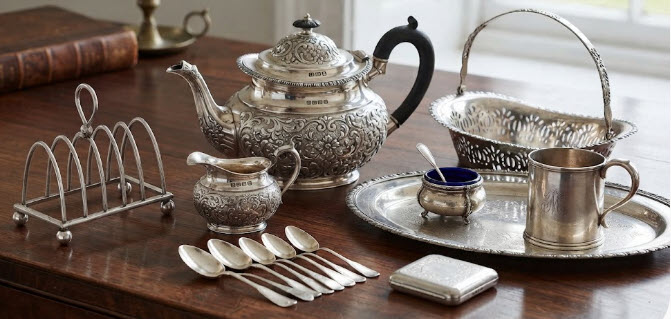
The Complete Guide to Collecting and Investing in English Silver (Origins to 1950)
English silver occupies a singular place in the history of decorative art. For centuries, the British statutory system of hallmarking has provided an unmatched roadmap of accountability, artistry, and heritage. Whether you are drawn to the austere elegance of early church plate, the ornate flourishes of the Rococo period, or the sleek geometric lines of Art Deco, collecting English silver bridges historical discovery with tangible investment potential.
Part 1: A Chronological History of English Silver (Beginnings to 1950)
To collect intelligently, one must understand how socio-economic shifts, royal decrees, and design revolutions shaped the silversmith’s craft.
1. The Early Origins and the Medieval Period (Pre-1500)
The Foundation of Standards: Systematic control of silver began in 1300 under King Edward I, who decreed that silver must match the coin standard (92.5% pure, later known as Sterling Silver) and mandated that items be brought to the Goldsmiths’ Hall in London to be stamped with the Leopard’s Head.
Scarcity: Due to centuries of melting down older plate to pay for wars, royal debts, or shifting fashions, domestic English silver from before the 16th century is exceedingly rare and almost exclusively museum-tier.
2. The Tudor and Stuart Periods (1500–1660)
The English Reformation: Much early ecclesiastical silver was destroyed or converted during the reign of Henry VIII and Edward VI.
The Lion Passant: Introduced in 1544, the walking lion (Lion Passant) became the universal hallmark for sterling purity alongside the Leopard’s Head.
Domestic Shift: Wealthy merchants began commissioning secular silver—such as seal-top spoons, tiger-ware jugs with silver mounts, and large standing cups.
3. The Restoration and the Britannia Period (1660–1720)
Post-Civil War Boom: Following the restoration of Charles II in 1660, luxury arts exploded. Elaborate toilet services, wine cisterns, and large chandeliers were crafted for the newly opulent court.
The Britannia Standard (1697–1720): To prevent the melting of silver coinage into plate, Parliament raised the required purity standard to 95.8% pure (Britannia Silver), substituting the Leopard’s Head with a lion’s head erased and the figure of Britannia. Pieces from this era carry a distinct, crisp, matte-white appearance.
4. Georgian Elegance: Rococo and Neoclassicism (1714–1837)
The Return to Sterling: In 1720, the standard reverted back to 92.5% sterling.
The Rococo Explosion (Mid-18th Century): Led by Huguenot refugees (such as Paul de Lamerie), silversmiths embraced asymmetrical designs, chasing, repoussé, and naturalistic motifs of shells, flowers, and scrolls.
Neoclassicism (Late 18th Century): Influenced by archaeological discoveries in Pompeii and Herculaneum, designers like Robert Adam shifted tastes toward clean architectural lines, urns, swags, and symmetry. This era perfected tea services, cruet sets, and old Sheffield plate innovations.
5. The Victorian Era and Industrial Mass Production (1837–1901)
Mechanization: Birmingham and Sheffield eclipsed older handicraft traditions as steam and machinery allowed for rapid stamping and manufacturing.
Eclecticism: The Victorians loved revivals—producing Gothic, Elizabethan, Rococo, and Renaissance revival pieces all at once.
The Duty Mark: Throughout much of this period (until 1890), a profile head of the reigning monarch (George III, George IV, William IV, or Victoria) was stamped to show that the silver tax had been paid.
6. Arts & Crafts, Art Nouveau, and Art Deco (1901–1950)
The Handcrafted Rebellion: In response to sterile Victorian industrialization, the Arts & Crafts movement (championed by guilds like the Birmingham Guild of Handicraft and makers like Omar Ramsden) returned to hand-beating, simplistic forms, and semi-precious stones.
Art Deco (1920s–1930s): Clean lines, geometric forms, zigzag patterns, and streamlined shapes dominated cocktail shakers, cigarette cases, and modern tea sets right up to the outbreak of World War II.
Part 2: Where Was It Made? Decoding Assay Offices and Hallmarks
A complete traditional British hallmark tells a micro-history of the object. It typically features four to five distinct stamps:
Maker’s Mark: Initials or symbols representing the craftsman or firm.
Purity Mark: The Lion Passant (Sterling .925) or Britannia (.958).
Assay Office (Town) Mark: The city where the piece was tested and legally cleared.
Date Letter: A specific letter font and shield shape corresponding to the exact year of assay.
Duty Mark (Historic): The sovereign’s head stamp used between 1784 and 1890.
Key Assay Offices to Know
London (Goldsmiths’ Hall): Marked by a Leopard’s Head (crowned before 1821, uncrowned thereafter). The premier and longest-running office.
Birmingham: Marked by an Anchor. Famous for small fancy goods, boxes, and vast Victorian output.
Sheffield: Marked by a Crown (until 1974). Historically dominant for flatware, heavy cutlery, and large platters.
Chester: Marked by Three Wheat Sheaves and a Sword (Office closed in 1962). Highly prized by regional collectors.
Edinburgh & Glasgow (Scotland): Edinburgh uses a Castle; Glasgow uses a Tree, Fish, Bell, and Bird. Note: Scottish silver often utilizes a Thistle or Lion Rampant instead of the English Lion Passant.
Provincial Offices (Now Closed): Historic offices like Exeter (Castle), York (Five lions on a cross), and Newcastle (Three castles) produced scarcer regional pieces that command high premiums today.
Part 3: Legendary Makers to Look Out For
Identifying the maker’s mark transforms a generic silver object into an attributed work of art. Keep an eye out for these master silversmiths:
Paul de Lamerie (Active 1712–1751, London): The undisputed master of English Rococo. His ornate, heavily chased baskets, candlesticks, and ewers are museum-grade treasures fetching monumental sums at international auction houses.
Hester Bateman (Active 1774–1790s, London): Perhaps the most famous female silversmith in history. Her workshop specialized in delicate, bright-cut engraved tea caddies, cream jugs, and sugar tongs characterized by incredible grace and restraint.
Paul Storr (Active 1792–1838, London): Working at the height of the Regency period, Storr created monumental, neo-classical dining silver, massive wine coolers, and presentation pieces often characterized by heavy cast vine-leaf and animal motifs.
Robert Garrard II (London): Operating as the Crown Jewellers, Garrard produced ultra-high-end presentation pieces, racing trophies, and lavish tableware for royalty and elite aristocracy.
Nathaniel Mills (Active 1826–1843, Birmingham): A premier specialist in miniature silver, famed for highly detailed, heavily chased card cases, snuff boxes, and vinaigrettes depicting historic landmarks like Windsor Castle or Scott’s Monument.
Elkington & Co. (Birmingham): Pioneers of commercial electroplating in the 1840s, but also massive producers of high-quality traditional sterling silver and exhibition-grade art metalwork.
Omar Ramsden (Active 1898–1939, London/Birmingham): A titan of the Arts & Crafts movement. His works feature distinctive hammered textures, stylized floral applications, and striking inscriptions.
Part 4: Collecting & Investment Potential: What to Buy
The silver market has evolved. While scrap silver value dictates the floor price of broken or mundane items, antique and collectible silver trades on artistry, condition, rarity, and historical provenance.
1. High-Potential Categories (Where Values Hold and Grow)
Early Provincial and Scottish Silver: Because regional assay offices produced far lower volumes than London, provincial pieces (especially Newcastle, Exeter, York, and Georgian/Victorian Scottish pieces) carry regional scarcity premiums.
Georgian Functional Holloware & Master Makers: Well-preserved tea sets, gravy boats, caddies, and trays by known makers (especially Hester Bateman and the Bateman family, Paul Storr, or specific Huguenot makers) consistently attract competitive bidding from global collectors.
Arts & Crafts and Art Deco Design Pieces: Signed pieces by Omar Ramsden, Archibald Knox (for Liberty & Co.), or high-end modernist Scandinavian-influenced British makers from the 1930s-1950s are heavily sought after by modern design collectors, driving strong price growth.
Novelty and Specialized Victorian Silver: Desk items, miniature vinaigrettes, articulated animal book-varks, and heavily engraved card cases are portable, displayable, and fiercely collected by niche enthusiasts.
2. Lower-Potential Categories (Approach with Caution)
Late Victorian and Edwardian Mass-Produced Flatware Canteens: Standard, heavily monogrammed plain cutlery sets or generic 20th-century silver services often struggle to appreciate rapidly because supply vastly outstrips modern domestic demand.
Heavy Victorian Presentation Salvers and Trophies: While masterwork pieces by Storr or Garrard hold value, mid-tier late 19th-century athletic or civic trophies are bulky, require extensive polishing space, and have a restricted buyer demographic.
Silver-Plate (EPNS): Unless it is by a visionary designer like Christopher Dresser for A.W. Driffield or Elkington, standard electroplated nickel silver holds little to no precious-metal investment value, functioning purely as utilitarian decor.
3. Golden Rules for Silver Investors
Condition is King: Look for crisp hallmarks, unthinned bowls (spoons worn down from centuries of heavy cleaning lose value), and minimal dents or clumsy repairs. Over-polishing that erases hallmarks destroys a piece’s collectible value.
Avoid Monogram Removal: While modern buyers sometimes dislike old monograms or family crests, removing them requires filing or buffing the metal down, which weakens the gauge and ruins the structural integrity of the piece. True collectors often appreciate crisp period engraving.
Buy Quality Over Quantity: One exceptional 18th-century cream jug by a listed maker will almost always outperform twenty mismatched, modern mass-produced souvenir spoons as a long-term asset.