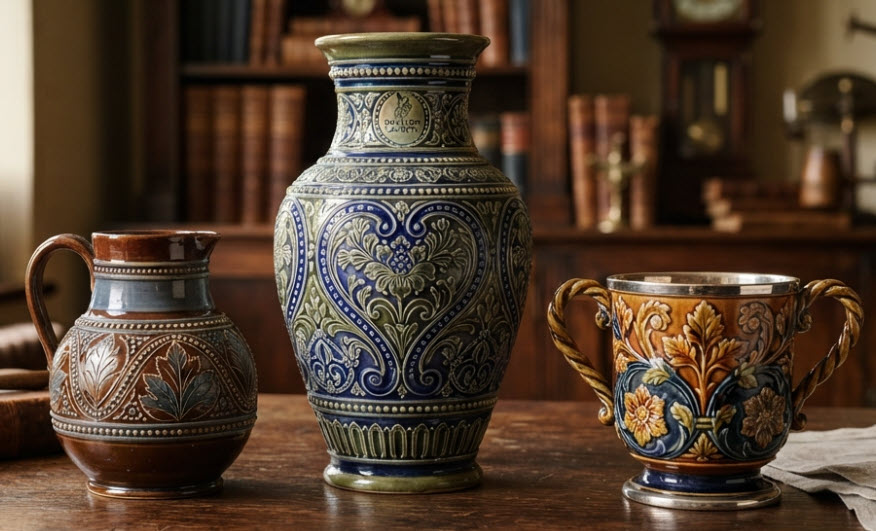
Art from the Mud and Salt: The Story of Doulton Lambeth Pottery
For anyone who appreciates Victorian craftsmanship, social history, or the tactile beauty of ceramic art, few names evoke as much admiration as Doulton Lambeth. Long before they became famous worldwide for fine bone china figurines and tea sets from Burslem, the heart of the Doulton empire beat loudly along the muddy banks of the River Thames in south London.
The Timeline: When Did It Start and Finish?
The roots of the pottery stretch back to 1815, when John Doulton partnered with John Watts to establish a modest pottery business in Vauxhall Walk, London, later moving to Lambeth High Street in 1826. Initially, the firm—trading as Doulton & Watts—focused primarily on utilitarian industrial stonewares: heavy-duty bottles, ginger beer flasks, inkwells, and industrial drainage pipes.
The turning point toward artistic ceramics happened in the mid-19th century. Following the retirement of John Watts and the formal establishment of Doulton & Co. in 1854 under the visionary leadership of Henry Doulton, the factory began experimenting with ornamental salt-glazed stoneware.
The Artistic Golden Age: Beginning around 1870, Henry Doulton forged a partnership with the nearby Lambeth School of Art. This collaboration infused industrial pottery with the creative energy of young designers and artists.
The Peak: Production and artistic ambition peaked in the late 19th century, when nearly 370 decorators and artists worked side by side at the Lambeth studios. In 1901, King Edward VII granted the company a Royal Warrant, allowing the use of the coveted “Royal” prefix.
The Closure: While ornamental stoneware production tapered down after World War I, a brief contemporary studio pottery revival was led by Agnete Hoy in the early 1950s. Ultimately, shifting economic landscapes and post-war rebuilding led to the closure of the Lambeth studios in 1956.
What Kinds of Pieces Did They Make?
Doulton Lambeth pottery is instantly recognizable due to its distinct materials and techniques. Unlike smooth, glossy porcelain, Lambeth wares celebrate texture, earthy chemistry, and hand-worked detail:
Salt-Glazed Stoneware: Fired at extremely high temperatures where common salt was thrown into the kiln, creating a characteristic orange-peel textured glaze with deep cobalt blues, rich browns, and ochres.
Impasto and Faience: The factory also produced Lambeth Faience (hand-painted underglaze earthenware plaques and vases) and Silicon or Imprata wares, which utilized contrasting matte and glazed textures.
Decorative & Architectural Forms: They crafted monumental exhibition vases, elaborate jardinieres, commemorative jugs, tobacco jars, and striking architectural terra cotta panels that still adorn buildings across London today.
The Master Artists of Lambeth
What truly elevated Doulton Lambeth above standard Victorian manufacturing was its stable of talented artists. Henry Doulton encouraged individual expression, requiring artists to sign, monogram, or initial their work alongside the factory stamp. Some of the most prolific names include:
Hannah Barlow (Active c. 1871–1913): Perhaps the most famous Lambeth artist, renowned for her breathtaking freehand incisions of animals—horses, cattle, lions, and goats—drawn into wet clay using a steel point before being highlighted with subtle coloring.
Florence Barlow (Active c. 1873–1909): Hannah’s sister, specializing in delicate, naturalistic paintings of birds, flowers, and foliage, often incorporating “pate-sur-pate” techniques.
Frank A. Butler (Active c. 1869–1911): A master of intricate, deeply carved geometric, Celtic, and Art Nouveau architectural patterns.
George Tinworth (Active c. 1867–1913): A legendary sculptor whose highly expressive, narrative terracotta panels and whimsical, anthropomorphic animal figures (such as “mouse musicians”) command intense admiration today.
Eliza Simmonds, Agnete Hoy, and dozens of other talented women who formed the backbone of the Lambeth decorating studio.
Is It Collected Now as Much as It Was Then?
While Victorian taste has experienced fluctuating cycles of fashion, high-end Doulton Lambeth stoneware remains fiercely competitive and deeply respected in the antiques market.
Then: In the late 19th and early 20th centuries, Doulton Lambeth pieces were prized luxury items, winning grand prizes at international exhibitions (such as Paris and Chicago) and collected by royalty and wealthy industrialists.
Now: Today, casual household items command modest prices, but signed pieces by master artists like Hannah Barlow or George Tinworth—especially large, flawless exhibition pieces—routinely achieve significant sums at major auction houses. Collectors value them not just as relics of a bygone era, but as unique, irreproducible works of studio art where every scratch and brushstroke was executed by a master hand.
What Does the Future Hold for Doulton Lambeth Collectors?
The future of collecting Doulton Lambeth pottery is shaped by a shift toward specialization, education, and preservation:
Appreciation for Craftsmanship: As mass-produced, digital goods dominate modern life, younger generations and contemporary ceramic artists are rediscovering the organic brilliance of Victorian salt-glaze and hand-carved stoneware. The sheer labor-intensive nature of these pieces ensures they will never be replicated cheaply.
The Rise of Niche Expertise: Because factory records and artist monograms are well-documented (thanks to collectors’ clubs and specialized reference guides), future collecting will rely heavily on provenance, condition, and exceptional artistic merit.
Museum and Institutional Legacy: With physical landmarks like the original Lambeth factory long demolished (cleared in 1976), surviving pieces serve as historical archives of London’s industrial and artistic heritage. Dedicated institutions—such as the Wiener Museum of Decorative Arts (WMODA)—ensure that the legacy of these Victorian artisans continues to inspire future generations.
If you own a piece with a crisp monogram and a rich salt-glaze finish, you are holding a genuine piece of Victorian history—one born from the mud of the Thames and elevated by extraordinary human talent.