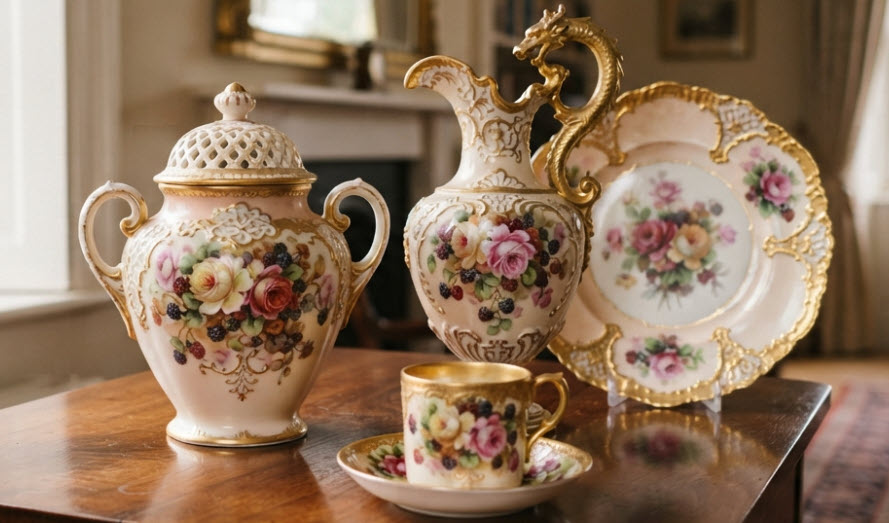
The Mastery of Royal Worcester Hand-Painted Wares: A Collector’s Guide
Royal Worcester holds a legendary status in the world of British ceramics. Founded in 1751 by Dr. John Wall and his partners, the factory evolved into a powerhouse of artistic expression, achieving global renown for its exquisite bone china and, most notably, its breathtaking hand-painted decorative wares. For collectors of British antiques, owning a piece of hand-painted Royal Worcester is the pinnacle of fine porcelain curation.
Master Artists: The Hand Behind the Brush
The allure of Royal Worcester hand-painted wares rests heavily on the extraordinary talent of the studio artists the company employed during its late 19th and mid-20th-century golden eras. Pieces bearing authentic signatures from these masters command the highest respect—and value—at auction.
The Stinton Family (John and Harry Stinton): Famous worldwide for their evocative depictions of Highland cattle in misty, atmospheric Scottish landscapes. Harry Stinton’s work, in particular, is fiercely sought after by collectors.
Charles Baldwyn: Widely celebrated as the master of painted birds, specifically his breathtaking, ethereal swans in flight against soft, graduated blue backgrounds.
Harry Davis: A versatile virtuoso known for landscapes, animals, fish, and winter snow scenes.
William Powell: The go-to artist for brilliantly detailed British and exotic birds.
Edward Raby & Kitty Blake: Raby specialized in delicate wild flowers, while Kitty Blake became an icon for her lush, tactile renderings of autumn blackberries and foliage.
History of Collecting: A Tradition That Endured
Have Royal Worcester pieces always been collected? Yes, but with an evolution.
In the 18th and early 19th centuries, high-end Worcester porcelain was created primarily for the aristocracy and royalty (securing its first Royal Warrant from George III in 1789). However, it was during the late Victorian and Edwardian periods—and continuing through the mid-20th century—that a dedicated connoisseur market blossomed.
Wealthy industrialists, interior decorators, and middle-class collectors actively sought out hand-painted fruit panels, “Blush Ivory” finishes, and intricate reticulated vases (such as those masterfully pierced by George Owen). Unlike mass-produced transferware, these hand-painted items were recognized immediately as unique works of art, cementing a steady, passionate collector base that spans generations.
The Museum of Royal Worcester: A World-Class Treasury
No exploration of Royal Worcester is complete without mentioning its spiritual home: The Museum of Royal Worcester (formerly the Dyson Perrins Museum) located on Severn Street in Worcester.
The Collection: Housed on the site of the original factory, the museum protects and displays the world’s largest collection of Worcester porcelain, boasting over 10,000 objects dating uninterrupted from 1751 to the factory’s closure in 2009.
Galleries: Visitors walk through three permanent eras—the Georgian Gallery (reflecting early craftsmanship and oriental influences), the Victorian Gallery (showcasing extravagant exhibition pieces and deep, rich colors), and the Twentieth Century Gallery.
Significance: It serves as the ultimate archive for authentic research, housing pattern books, artist signature records, and historic showpieces like the monumental Chicago Vase.
Which Artists and Styles Are Best to Collect Today?
If you are building or expanding a collection, certain categories offer the strongest aesthetic and financial reward:
Signed Fruit Pieces (circa 1910–1960s): Vases, pot pourris, and plates painted with lush, dewy fruit (apples, grapes, and berries against a mossy background) by artists like Freeman, Ayrton, or Townsend are the holy grail of Worcester collecting.
Highland Cattle by Harry or John Stinton: These pastoral scenes carry immense visual appeal and remain exceptionally liquid on the secondary market.
Blush Ivory Wares: Characterized by a warm cream Parian body with a matt straw-toned exterior, subtle apricot spray, and raised gilding. They offer an accessible entry point into fine decorative Victorian collecting.
Current Market Value and Stability
Is the market stable, and is it still avidly collected? The market for top-tier, investment-grade Royal Worcester is remarkably stable and resilient. While everyday domestic tableware has seen fluctuations due to changing modern interior tastes, masterpiece-quality hand-painted decorative wares—especially signed fruit, high-end cattle scenes, and rare exhibition shapes—continue to command strong prices at major international auction houses.
Price Tiers: Entry-level signed small dishes or cabinet plates can range from several hundred pounds, while large, pristine, fully signed fruit-painted twin-handled vases by master artists can easily achieve thousands.
What Buyers Look For: Condition is absolute king. Collectors meticulously inspect for hairline cracks, chips, restoration, or rubbed gilding. A piece in flawless condition with clear factory date codes and a prominent artist signature will always find an eager buyer pool.
Royal Worcester hand-painted porcelain is far more than antique decor; it represents a golden age of British ceramic artistry that continues to captivate passionate collectors across the globe.
Decoding Royal Worcester: Date Marks, Dots, and Backstamps
To accurately date a piece of Royal Worcester, you have to look closely at the base for the factory’s signature backstamp. Royal Worcester is famous among British ceramic collectors for having one of the most meticulously structured dating systems in the antiques world.
The standard modern Royal Worcester printed mark features a circle enclosing the number 51 (representing the factory’s founding year of 1751) topped by a crown. Over the decades, tiny adjustments to this mark—specifically letters, dots, stars, and geometric shapes—tell you the exact year the item was crafted.
1. The Letter Period (1867–1891)
Following the 1862 restructuring into the Worcester Royal Porcelain Co., the factory began adding date letters below the standard mark.
Starting with A in 1867, the letters proceeded alphabetically year by year (skipping J, Q, etc.) to track production.
By the late 1870s and 1880s, capital letters like M (1877), N (1878), and R (1880) pinpoint the late Victorian era.
2. The Dot System (1892–1915)
When the alphabet sequence wrapped up, Royal Worcester introduced a clever system of tiny dots placed around the crown and circle to signify years:
1891: Standard printed mark with the word “England” added, but no dots.
1892: 1 dot on the left side of the crown.
1893–1899: Dots gradually accumulate symmetrically on both sides of the crown (e.g., 3 dots left and 2 right for 1896).
1904–1915: Once dots flanked the sides of the crown fully, the factory started adding extra dots underneath the central circle, counting upward year by year until 1915 (which reached 12 dots underneath).
3. Stars and Geometric Shapes (1916–1941)
As adding dots to copper plates became unmanageable, the factory streamlined the process:
1916–1927: A small star/asterisk (*) was placed below the mark. From 1917 onward, dots were added next to the star to count the years (star + 1 dot for 1917, star + 2 dots for 1918, up to star + 11 dots for 1927).
1928–1930: The system shifted to geometric symbols placed beneath the mark:
1928: Open square
1929: Open diamond
1930: Division sign ($\div$)
1931–1941: A system of interlinked circles accompanied by dots tracked the 1930s leading into WWII (e.g., two linked circles for 1931, three circles for 1932, adding dots sequentially through 1941).
4. Post-War Codes (1942–1963)
1942–1948: Generally featured standard black printed marks without specific year-dating symbols.
1949–1963: Utilized letter prefixes like V (1949) and W (1950), followed by dots added to the W from 1951 (W + 1 dot for 1951, W + 2 dots for 1952, continuing through the early 1960s).