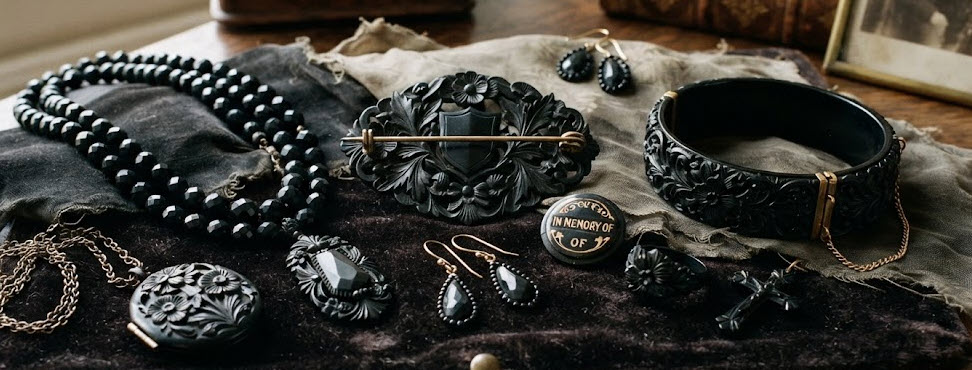
The Mourning and the Magnificent:
The blackness of Victorian Jet Jewellery
To hold a piece of authentic Victorian jet jewellery is to hold a fragment of deep history, frozen in time. Lightweight, velvety to the touch, and gleaming with a deep, midnight-black lustre, jet was the ultimate arbiter of style and solemnity during the 19th century.
While it is most famously associated with the sombre, protracted grief of Queen Victoria, jet was far more than a symbol of mourning. It was a technological marvel of its era, a triumph of British craftsmanship, and a fashion statement that graced the necklines and wrists of Europe’s most elite circles.
What is Jet?
True jet is not a stone or a mineral; it is a form of lignite, a precursor to coal. It is formed from the fossilized wood of ancient trees (primarily the Araucaria, or monkey puzzle tree family) that were buried under immense pressure and subjected to seawater millions of years ago.
What sets jet apart from ordinary coal is its organic uniformity. Because it is fossilized wood compressed over millennia, it can be carved with exquisite, lace-like precision without splintering, and it can be polished to an intense, permanent sheen.
The Capital of Jet: Whitby
While jet has been used for ornamentation since the Bronze Age, the global epicentre of the Victorian jet industry was the seaside town of Whitby in North Yorkshire, England.
Whitby jet was prized above all other varieties for its superior quality—it was harder, took a much higher polish, and was completely black (unlike Spanish jet, which often had a brownish undertone). By the mid-19th century, Whitby was a bustling boomtown, home to hundreds of master carvers working in small cliffside workshops, turning the raw black “driftwood” into wearable art.
The Royal Stamp of Approval
Jet’s rise from a regional craft to a global luxury phenomenon was cemented by none other than Queen Victoria.
Following the death of her mother, the Duchess of Kent, and subsequently her beloved husband, Prince Albert, in 1861, the Queen plunged into a state of profound, lifelong mourning. Her strict, mandated court etiquette dictated that courtiers and society figures alike must follow suit.
-
The Court Etiquette: During full mourning, jewellery was strictly limited to non-reflective, matte or faceted black materials. Jet was the premier choice because it met these rigorous dress codes while still offering an elegant, refined texture.
-
The Trendsetter Effect: As Queen Victoria was photographed and painted wearing elaborate jet parures (matching sets of jewellery), the British aristocracy and the burgeoning middle class rushed to emulate her. Wearing jet became a powerful cultural signifier of loyalty, taste, and emotional depth.
Beyond Grief: A Shift to High Fashion
Though born of sorrow, jet quickly transcended the boundaries of mourning wear. By the 1870s and 1880s, Victorian fashion had embraced jet for everyday luxury, evening wear, and summer fashion.
-
The Little Black Dress Precursor: In an era of heavy, colorful silks and velvets, a sweep of dark, faceted jet beads offered a stunning, high-contrast accent against lighter fabrics like white lace, lavender, and grey silk.
-
Versatility in Design: Master artisans carved jet into breathtakingly intricate forms—delicate flora and fauna (such as ivy leaves symbolizing fidelity and oak leaves for strength), classical cameos, geometric facets that caught the candlelight, and heavy, dramatic mourning lockets containing hairwork of departed loved ones.
Imitations and the Beginning of the End
Because genuine Whitby jet was expensive and labor-intensive to produce, the market was quickly flooded with more affordable alternatives:
-
French Jet: Actually black glass (paste), which was heavier, felt cold to the touch, and could be identified by tiny air bubbles under a loupe.
-
Vulcanite and Gutta-Percha: Early forms of hardened rubber that could be easily molded into complex, repeating patterns using industrial presses.
-
Bakelite and French Composition: Later plastics that emerged toward the end of the Victorian era.
The demand for jet eventually waned by the turn of the 20th century. Tastes shifted toward the bright, glittering optimism of the Edwardian era and the dazzling diamonds and platinum of the Belle Époque, while the relaxation of rigid mourning customs reduced the cultural need for black ornaments. Furthermore, the Whitby mines were largely depleted by the early 1900s.
Collecting Victorian Jet Today
Today, antique jet jewellery is highly sought after by vintage enthusiasts and historians alike. If you are looking to start a collection, keep these insider tips in mind:
-
The Warmth Test: Unlike glass (“French jet”) or metal, genuine jet is an organic material that absorbs room temperature. When you hold a piece of real jet in your hand, it will feel surprisingly light and will warm up quickly against your skin. Glass will remain cold.
-
The Streak Test (Proceed with Caution): If unpolished, true jet will leave a brownish-black streak if rubbed across an unglazed porcelain tile. (Be very careful doing this with finished antique pieces!)
-
Inspect the Carving: High-end Victorian jet features crisp, hand-carved details with deep relief, whereas molded substitutes often show softer edges or mold seams.
-
Care for Your Pieces: Jet is relatively soft (ranking around 2.5 to 4 on the Mohs hardness scale). It can scratch easily and should never be cleaned with harsh chemicals, ultrasonic cleaners, or soaked in water. A gentle wipe with a soft, dry microfiber cloth is all it needs to maintain its historic glow.
Owning a piece of Victorian jet is like wearing a piece of poetry—a bridge between the ancient forests of pre-history and the romantic, dramatic elegance of 19th-century art.