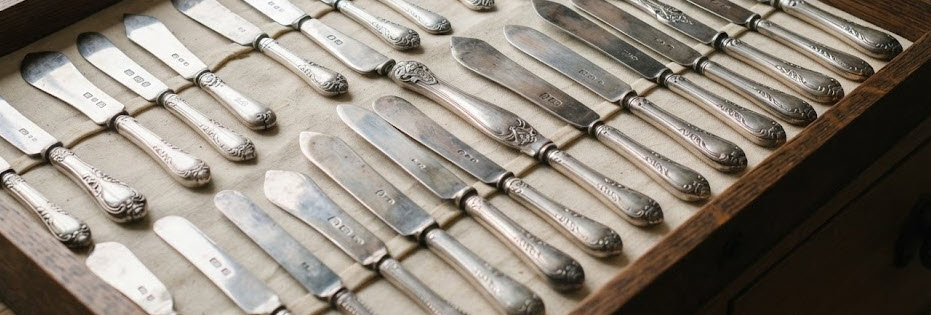
The Ultimate Overlooked Collectable: Solid Silver Butter Knives
If you look into a traditional antique silver cabinet, you will usually find rows of heavy forks, standard spoons, and ornate ladles. But tucked quietly away in the corners are small, exquisitely crafted pieces of art that most modern collectors walk right past: solid silver butter knives and spreaders.
Long viewed as mere kitchen accessories, solid silver butter knives are rapidly emerging as a hidden gem in the antiques market. They are affordable, intensely decorative, packed with history, and small enough that you can build an impressive collection without taking up a room in your house.
A Slice of History: The Evolution of the Butter Knife
While butter has been consumed for millennia, specialized tools for serving it didn’t truly flourish until dining etiquette became an art form in Europe and America.
-
The Georgian Era (1714–1830): Early butter knives were often large, master butter knives designed to cut and transfer a block of butter from a communal dish to a plate. Many featured scimitar-shaped blades or hollow handles filled with sealing wax to secure the steel blade to the silver handle.
-
The Victorian Era (1837–1901) — The Golden Age: This is where things get fun for collectors. During the Victorian “specialization craze,” the dinner table exploded with single-purpose implements. Victorians developed distinct tools for everything, giving rise to the individual butter spreader (shorter, rounded blades meant for personal bread-and-butter plates) alongside ornate master knives.
-
The Edwardian Era & Beyond (1901–1914+): Designs shifted toward lighter, highly intricate floral motifs, art nouveau curves, and combinations involving handles made of mother-of-pearl, ivory, or loaded silver.
Where Were They Made? (The Hotspots)
If you start hunting for solid silver butter knives, you will typically find pieces originating from three primary epicenters of historic silversmithing:
1. United Kingdom (London, Birmingham, Sheffield)
The UK is the absolute epicenter for marked sterling silver.
-
What to look for: British pieces will feature a suite of hallmarks—typically a purity mark (like the Lion Passant for sterling), an assay office mark (such as a leopard’s head for London or an anchor for Birmingham), and a date letter.
-
Why collect them: British silversmiths loved embellishment. You can find Victorian butter knives featuring engraved blades, chased handles molded into sheaves of wheat or ivy, and cast silver handles depicting deer, stags, or geometric scrollwork.
2. The United States (New England and the Mid-Atlantic)
During the late 19th and early 20th centuries, American manufacturers like Gorham, Tiffany & Co., Towle, and Reed & Barton produced breathtaking sterling flatware lines.
-
What to look for: American pieces from this era are usually stamped “Sterling” or “Coin Silver” (for pieces pre-Civil War).
-
Why collect them: American butter spreaders often match famous full-service flatware patterns. Collecting them allows you to own miniature pieces of iconic silver design history without paying the high price tag of a full 12-person flatware set.
3. Continental Europe (France, Germany, and the Netherlands)
European makers produced stunning pieces, often utilizing higher or differing purity standards (such as the French Minerva head mark or German 800/835 silver grades). European butter knives frequently feature whimsical, rococo-revival flourishes or distinct regional blade shapes.
Why Solid Silver Butter Knives Make the Ultimate Collection
If you are trying to convince a friend—or yourself—to take the plunge into collecting, butter knives check every single box:
-
Incredible Affordability: While a solid silver tea set or a large tray can cost thousands, individual antique sterling silver butter knives can frequently be found at estate sales, auctions, and antique shops for a fraction of the cost—often ranging from modest prices up to a hundred dollars for rare maker-signed pieces.
-
History You Can Hold: A late-Victorian butter knife has sat on formal dining tables through world wars, shifting empires, and generational family dinners. Each hallmark tells an exact chronological story of who made it and where.
-
Zero Storage Stress: Unlike bulky porcelain or heavy furniture, a collection of dozens of silver butter knives can be displayed neatly in a small wall-hung shadow box, a tabletop tray, or safely kept in a compact drawer chest.
-
Material Value: Because they are made of solid sterling silver (.925 purity), they carry intrinsic precious-metal value, giving your hobby a built-in safety net.
Tips for Beginner Collectors
-
Beware of Silverplate: Always check for hallmarks. Stamps like EPNS (Electro-Plated Nickel Silver) or “Silverplate” mean the piece has only a microscopic layer of silver over a base metal. Look for “Sterling,” “925,” or country-specific purity symbols (like the British lion) to ensure you are buying solid silver.
-
Inspect the Blade and Handle: Many antique knives feature hollow handles or are cemented together with resin/wax. Avoid soaking them in hot water or putting them in the dishwasher, as this can melt the internal cement and loosen the blade.
-
Embrace the Quirks: Look out for butter knives with “hollow blades” engraved with ferns, or blades featuring miniature pierced slots designed to keep soft butter from sticking.