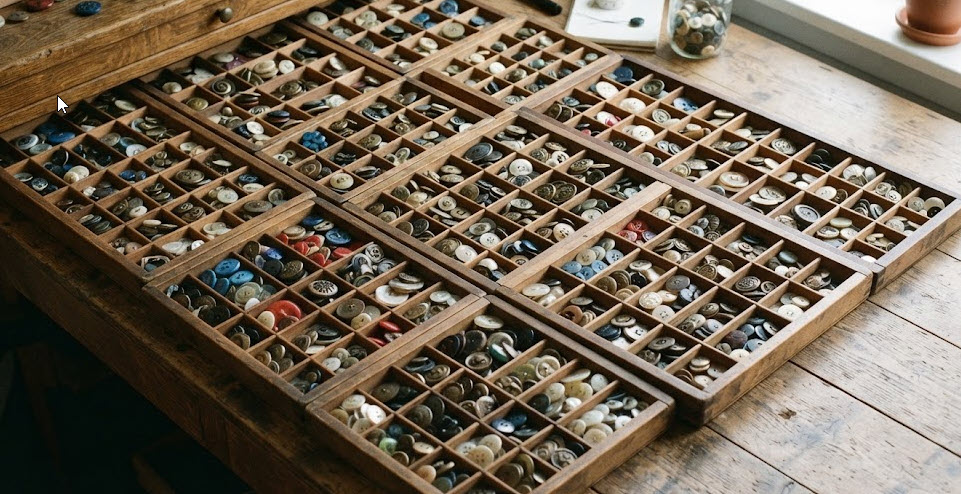
The Small Stuff of History: A Comprehensive Guide to Collecting Buttons from Roman Times to Today
Buttons are among the most intimate and overlooked artifacts of human history. Pinned to our chests, cuffs, and collars, they have fastened the garments of Roman legionaries, Tudor courtiers, Victorian dandies, and modern commuters.
To the casual observer, a button is merely a functional fastener. To the collector, however, a single button is a micro-archive: a tangible snapshot of metallurgy, fashion, socio-economic status, and manufacturing technology across millennia.
1. The Ancient and Medieval Foundations (Roman to Gothic Era)
While the Romans are famous for their draped togas and cloaks fastened by fibulae (brooches and pins), they did use early forms of buttons—though mostly as decoration or seals rather than practical fasteners.
Roman and Byzantine Roots
Material & Design: Roman buttons were typically small, conical or spherical, cast in bronze, bone, or glass, and sewn onto garments primarily for ornamentation. True functional buttonholes were rare in classical antiquity, as tunics and togas relied on belts, folds, and brooches.
The Transition: It wasn’t until the High Middle Ages (around the 13th century) that tailoring underwent a revolution. The invention of tightly fitted garments for both men and women required a reliable way to close clothing securely.
The 13th-Century Tailoring Revolution
The Shift: Around 1250–1300, European tailors began cutting garments on the bias to hug the human form. This made functional buttonholes and closely spaced buttons a necessity.
Materials: Medieval buttons were fashioned from lead-tin alloy, bone, wood, and horn, often cast in simple molds or hand-carved.
2. The Golden Age of Craftsmanship (16th to 18th Century)
As European fashion grew increasingly elaborate during the Renaissance and Baroque periods, buttons transformed from simple fasteners into miniature canvases of high art and status.
Tudor and Elizabethan Elegance (16th Century)
Status Symbols: Wealthy Elizabethans wore garments encrusted with decorative buttons made of gold, silver, pearls, and precious stones. Sumptuary laws occasionally restricted who could wear certain button materials based on social class.
Fabric-Covered Buttons: Hand-embroidered silk and thread buttons emerged, matching the exact fabric of the doublet or gown.
The Georgian and Eighteenth-Century Masterpieces (1700s)
The 18th century is widely considered the golden age for button collectors. Men’s coats, waistcoats, and breeches featured rows of oversized, ornate buttons.
Pinchbeck and Cut Steel: Invented by Christopher Pinchbeck, an alloy resembling gold became popular for affordable luxury. Simultaneously, English manufacturers (notably in Birmingham) mastered cut-steel buttons, where hundreds of tiny steel facets were riveted onto a base to catch the candlelight like diamonds.
Enamel and Porcelain: Limoges enamels and painted porcelain buttons depicted pastoral scenes, mythological figures, and portraits, reflecting the artistic tastes of the Enlightenment.
Horn and Bone Carving: Artisans carved intricate geometric patterns, sporting motifs, and floral designs into natural horn and bone for middle-class wearers.
3. The Industrial Revolution and Mass Production (19th Century)
The 19th century democratized fashion. Powered by the Industrial Revolution, button production shifted from bespoke handcrafts to mass-manufactured goods, introducing exciting new materials for the Victorian collector.
Key Victorian Styles and Innovations
Passementerie: Intricately braided silk, velvet, and thread buttons dominated mid-19th-century women’s dresses.
Glass and Jet: Black glass and genuine Whitby jet buttons surged in popularity following the death of Prince Albert, as Queen Victoria popularized long periods of formal mourning.
Bakelite and Early Plastics: The late 19th century saw the introduction of early semi-synthetic plastics like Celluloid and Casein (derived from milk protein), allowing for vibrant colors and molded textures that imitated tortoise shell or ivory.
Military and Uniform Buttons: The 19th century was the golden era of military buttons. Regiments across the globe commissioned distinct brass and white-metal buttons stamped with crests, numbers, and insignia, making militaria a massive sub-genre of button collecting today.
4. Modernity and the 20th Century to Today
As fashion shifted toward comfort, practicality, and casual wear in the 20th century, buttons adapted to mass-market production while retaining artistic flair through the Art Deco and Mid-Century movements.
Art Deco (1920s–1930s): Geometric lines, symmetrical patterns, molded plastics, and stark contrasting colors defined the jazz age. Bakelite became the king of modern buttons.
Post-War Plastic and Nylon: The invention of cheap, durable thermoplastics (like polyester and nylon) meant buttons could be manufactured by the millions in any color imaginable, largely replacing natural materials for everyday garments.
Designer and Novelty Buttons: Haute couture houses (Chanel, Dior, Schiaparelli) elevated buttons into iconic branding elements—most notably Coco Chanel’s embossed metal buttons featuring the interlocking CC logo or lion motifs.
5. How to Start Your Own Button Collection
Button collecting (known formally as campanology to some, though “button collecting” is universally understood) is an accessible, highly rewarding hobby. Here is how to get started:
Pro Tip: You don’t need to empty your savings account. A wonderful collection can be built by visiting local antique malls, flea markets, estate sales, and vintage clothing stores.
1. Choose a Collecting Focus
Because buttons span thousands of years and millions of designs, narrowing your focus helps structure your collection:
By Era: Focus exclusively on 18th-century cut-steel or Victorian mourning buttons.
By Material: Specialize in porcelain, Bakelite, brass, wood, or shell.
By Theme: Collect pictorial buttons (animals, sports, famous figures) or military/uniform buttons.
2. Inspecting and Dating Buttons
Shanks vs. Holes: Shank buttons (where the loop is on the back) are generally older, though flat buttons with two or four holes became dominant with industrial sewing machines.
Backmarks: On 19th- and 20th-century metal buttons, look for manufacturer stamps on the reverse side (backmarks), which can help pinpoint the maker and date.
3. Preservation and Display
Mounting: Never glue antique buttons. Instead, mount them on heavy, acid-free cardstock or velvet-lined display trays using thread or archival photo corners.
Cleaning: Clean metal buttons gently with a soft cloth. Avoid harsh chemical polishes on antique brass or silver, as a natural patina often adds historical value and character.
Conclusion
From the bone fasteners of medieval peasants to the shimmering cut-steel masterpieces of Georgian courtiers and the vibrant plastics of the 20th century, buttons serve as a tangible timeline of human culture. They remind us that history isn’t just written in books—sometimes, it’s sewn right onto our sleeves.