ROLEX
The Crown Jewel of Modern Horology
A Short Guide to Its History, Iconic Watches and Collecting Appeal
An independent publication. Not affiliated with or endorsed by Rolex.
Introduction: More Than a Name on a Dial
A Rolex can be a precision instrument, a personal milestone or a collector’s prized possession. Its appeal rests on a combination of technical development, recognisable designs and a history that connects wristwatches with exploration, travel and sporting achievement. Rolex’s own historical record traces this journey from Hans Wilsdorf’s London business in 1905 to watches built for diving, international aviation and motor racing.
Yet the Rolex story is also surrounded by confident claims and popular misconceptions. Its charitable ownership is sometimes confused with non-commercial operation. Strong resale demand is sometimes presented as a promise that every watch will increase in value. Neither description tells the whole story.
This short book explores what made Rolex important, why its best-known watches remain desirable and how to think sensibly about their financial appeal.
Chapter One: A Swiss Legend with London Roots
The story begins not in Geneva, but in London.
In 1905, the 24-year-old Hans Wilsdorf established a business distributing timepieces. At a time when wristwatches still faced doubts about their precision, he recognised their potential to become reliable everyday instruments rather than merely decorative accessories. He equipped his watches with small Swiss movements manufactured in Bienne, bringing together a London business and Swiss watchmaking expertise.
This was the foundation of a powerful idea: a watch worn on the wrist could be both elegant and dependable.
The Birth of Rolex
In 1908, Wilsdorf chose the name Rolex. In the company’s account, he wanted a short, memorable name that worked across languages and looked attractive on a watch movement and dial. He later recalled that the name came to him while travelling along Cheapside on a horse-drawn omnibus.
The name became associated with a sustained effort to demonstrate precision. In 1910, a Rolex became the first wristwatch to receive the Swiss Certificate of Chronometric Precision from the Official Watch Rating Centre in Bienne. Four years later, Kew Observatory awarded a Rolex wristwatch a Class A precision certificate, a distinction previously associated with marine chronometers.
These achievements mattered because they challenged the assumption that a small wristwatch could not deliver serious timekeeping performance.
From London to Geneva
Rolex moved to Geneva in 1919, and Montres Rolex S.A. was registered there in 1920. Its identity became firmly Swiss, but its beginnings remained rooted in London and Wilsdorf’s early ambition to make the wristwatch a trustworthy companion.
Chapter Two: The Oyster and the Perpetual
Two developments became central to Rolex’s identity: protecting the movement from the outside world and making everyday winding more convenient.
The Oyster: Protection for the Movement
In 1926, Rolex introduced the Oyster, a wristwatch with a sealed case designed to protect its movement from water and dust. Rolex describes it as the first waterproof and dustproof wristwatch. For historical writing, it is useful to attribute that “first” to the manufacturer rather than treat a broad priority claim as beyond debate.
The important point is what the Oyster represented: a practical approach to making a delicate mechanical instrument more resilient.
In 1927, swimmer Mercedes Gleitze wore a Rolex Oyster during an English Channel swimming attempt lasting more than ten hours. According to Rolex, the watch remained in working order afterwards. The company publicised the achievement with a front-page advertisement in the Daily Mail.
The episode brought engineering and publicity together. A technical claim became a story the public could understand.
The Perpetual Rotor
In 1931, Rolex patented its Perpetual rotor self-winding mechanism. The rotor used movement of the wearer’s wrist to help wind the mainspring, reducing dependence on daily manual winding. Rolex’s specific achievement concerned its rotor mechanism; it should not be simplified into a claim that the company invented every form of automatic watch.
Together, the Oyster case and Perpetual winding system expressed the same ambition: a wristwatch should be convenient, dependable and suited to regular use.
The Datejust
Rolex introduced the Datejust in 1945. The company describes it as the first self-winding wrist chronometer to display the date in a window on the dial. It also introduced the Jubilee bracelet, created for the model.
Where the Oyster and Perpetual developments addressed protection and winding, the Datejust added everyday information in an immediately readable form.
Chapter Three: Three Watches That Defined an Era
During the 1950s and 1960s, Rolex expanded its professional watch range. Three models became especially important: the Submariner, GMT-Master and Cosmograph Daytona. Each connected a practical function with a distinctive visual identity.
The Submariner: Built for the Water
Launched in 1953, the Submariner was waterproof to 100 metres. Its rotating bezel allowed divers to monitor immersion time, making it a purpose-designed instrument rather than simply a conventional watch with greater water protection.
The collection subsequently developed further. Today’s Submariner and Submariner Date have a stated water resistance of 300 metres, while the date-equipped version first appeared in 1969.
Its lasting appeal lies in the relationship between appearance and function. The prominent bezel is not merely decoration: it explains what the watch was designed to do.
The GMT-Master: A Watch for a Connected World
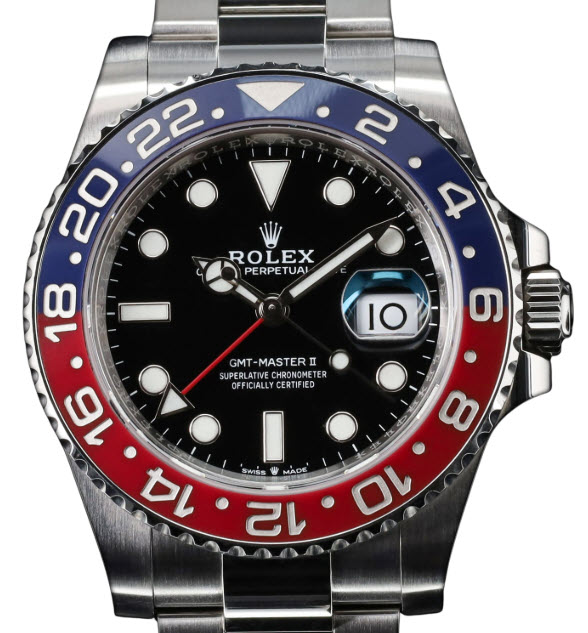
Introduced in 1955, the GMT-Master was designed as a navigation aid for people travelling across time zones. It became associated with professional aviation and was adopted by airlines including Pan American World Airways, better known as Pan Am.
Its distinguishing features included a 24-hour display system and a two-colour bezel that differentiated daytime from night-time hours. These practical elements also gave the watch a highly recognisable appearance.
The GMT-Master tells a different story from the Submariner. One belongs to the underwater world; the other reflects the growing importance of international air travel.
The Cosmograph Daytona: Timing and Motor Racing
The Cosmograph Daytona arrived in 1963. Its chronograph function allowed the measurement of elapsed time, linking the watch with motor racing and the demands of performance timing.
A chronograph is, in simple terms, a watch with an additional stopwatch function. This distinguishes it from a watch whose sole purpose is to show the time.
Alongside the Submariner and GMT-Master, the Daytona illustrates a recurring Rolex approach: give a watch a clear professional purpose and a design that communicates that purpose.
Chapter Four: Who Owns Rolex?
One of the most interesting aspects of Rolex is its ownership.
The Hans Wilsdorf Foundation was created in 1945. The foundation describes itself as a private shareholder foundation, the owner of the Rolex group, and an organisation whose income comes from the group’s dividends and supports public-interest objectives.
The distinction between owner and business is important.
Rolex manufactures and sells watches commercially. Its charitable owner does not make an individual watch purchase a charitable donation, nor does it mean that the watchmaking company operates without a profit motive. The more accurate description is a commercial watchmaking business owned by a foundation with philanthropic purposes.
How Many Watches Does Rolex Make?
Annual production figures should be treated as estimates rather than an officially disclosed count. Published estimates place production at roughly one million watches a year, with some reporting around 1.15 million.
A large annual total also tells a buyer relatively little about the availability of one particular model. Production across a brand is not the same thing as supply of a specific reference, material or dial configuration.
Chapter Five: Understanding Rolex Prices
To understand Rolex values, begin by separating two different markets.
Retail Prices
Retail prices are the official prices charged for new watches through the authorised distribution network.
It is tempting to describe these as rising by a fixed percentage every year, but increases differ by model, material and country. For example, reported UK adjustments in early 2025 ranged from less than 1% for certain models to approximately 3% for the steel Daytona. A universal annual increase of 3%–5% would therefore be too rigid a claim.
For a publication intended to remain useful, the safer wording is:
“Rolex periodically increases retail prices, but the size and timing of adjustments vary.”
Secondary-Market Prices
Secondary-market prices are what buyers pay outside the original authorised retail sale. This includes pre-owned watches and watches resold in unworn condition.
These prices can move independently of official retail prices. Some watches command premiums; others trade below retail. In early 2025, Morgan Stanley and WatchCharts data reported that approximately 53% of the current-production Rolex models they tracked traded above retail, down from around 68% a year earlier.
That finding is important: even within Rolex, a resale premium is not universal.
The Boom and the Correction
The secondary watch market experienced a pandemic-era surge that culminated in record prices in 2022. It then endured a prolonged correction. By the first quarter of 2025, the pace of decline had slowed, and the tracked Rolex index rose slightly over the quarter.
Later reporting on the WatchCharts/Morgan Stanley review put Rolex’s overall secondary-market gain for 2025 at 4.6%, although the final quarter was flat. This suggests recovery in that period, not proof that future prices will follow a smooth upward path.
A market can stabilise without becoming predictable.
Chapter Six: Is a Rolex an Investment?
The most useful word in this discussion is discipline.
A Rolex may retain value well, and some examples may appreciate. However, historical price corrections show that ownership also involves financial risk. A respected brand does not remove the possibility of paying too much or selling at a loss.
Purchase Price Changes the Outcome
Consider a hypothetical example.
One buyer obtains a watch for £9,000. Another pays £14,000 for the same reference during a period of intense demand. If both later sell for £11,000, the first buyer makes a gross gain and the second makes a gross loss.
The brand and watch are the same. The purchase price changes the result.
These illustrative figures are not market quotations, and they exclude all ownership and selling costs.
Liquidity Is Not a Guarantee
Liquidity describes how readily something can be converted into money. Rolex has a substantial secondary market, and recent reporting identifies it as a leading brand in pre-owned trading. That broad market presence should not be confused with a guarantee that every example can be sold immediately at an attractive price.
Condition, originality, reference, price and the depth of demand all affect resale prospects. Market specialists therefore assess the particular watch, not simply the name on its dial.
An immediate dealer offer may also produce a different result from a patient private sale. “Easy to find a buyer” and “certain to recover the full purchase price” are different claims.
A More Balanced Approach
For a prospective owner, the sensible principle is to buy a watch whose enjoyment does not depend on appreciation.
Any financial assessment should distinguish:
The amount paid.
The likely proceeds from selling, rather than an optimistic advertised price.
Ownership and transaction costs.
The length of time the buyer expects to keep it.
The possibility that market demand may weaken.
This is a framework for evaluating a purchase, not a prediction of investment performance.
Chapter Seven: The Next Ten Years
A ten-year outlook should describe possibilities rather than promise results.
Rolex enters that discussion with a long-established identity and substantial activity in the secondary market. Its professional watches connect recognisable designs with histories in diving, aviation and motor racing, while its foundation ownership distinguishes its corporate structure from that of a publicly traded luxury group.
Those characteristics help explain its appeal. They do not determine what an individual watch will be worth in ten years.
Three Possible Paths
The following are scenarios, not forecasts.
Continued strength
Demand remains resilient, and sought-after references maintain strong resale interest. Owners who bought carefully may experience favourable outcomes.A more selective market
Collectors place greater emphasis on specific references, originality and condition. Some watches perform well while others remain flat or become less desirable.Another correction
Buyer enthusiasm weakens or resale supply increases. Watches purchased at substantial premiums become especially exposed to losses.
The recent record supports caution about certainty: a sharp market boom was followed by several years of falling prices, then signs of stabilisation and recovery. No single phase should be treated as a permanent condition.
What Buyers Can Control
Buyers cannot control the wider market, but they can control their research, purchase price and willingness to walk away.
A practical assessment starts with the exact reference and the individual watch. Condition and originality matter, while evidence of actual transactions is more useful than relying solely on ambitious asking prices. These are among the factors highlighted by specialists assessing the pre-owned market.
The objective is not to predict the future perfectly. It is to avoid needing a perfect future to justify the purchase.
Conclusion: Understanding the Crown
Rolex’s rise rests on more than prestige. Its history includes early achievements in wristwatch precision, the protective Oyster case, the Perpetual rotor and professional watches designed for specific environments. These developments explain how a business founded in London became a major name in Swiss watchmaking.
Its financial reputation deserves a similarly careful reading. Rolex has a deep secondary market, but individual outcomes vary, and its watches have participated in both rising and falling markets.
The strongest appreciation of Rolex combines an interest in the watch with a clear understanding of the purchase. History can explain the attraction. Research can improve the decision. Neither can guarantee the resale price.
A Short Glossary
Chronograph: A watch with a stopwatch function in addition to its time display.
Chronometer: A precision-tested timepiece; the term concerns timekeeping performance, not a stopwatch function.
Perpetual rotor: Rolex’s self-winding rotor system, patented in 1931.
Reference: The identifier used to distinguish a particular watch model or version.
Secondary market: The resale market outside the original retail transaction.
Liquidity: The ease with which an asset can be sold for money.
Resale premium: The amount by which a secondary-market price exceeds the corresponding retail price.
Editorial note: Production estimates and market information reflect the cited reporting available when this manuscript was prepared. This is an independent historical and educational overview, not personalised financial advice.