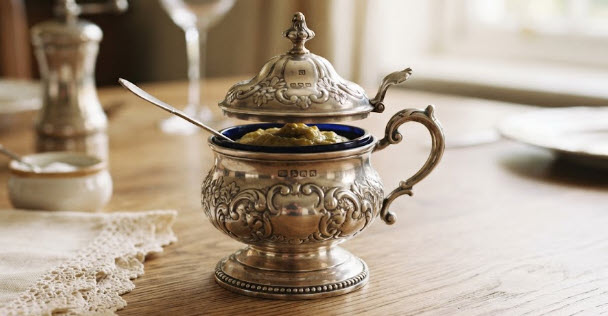
The Timeless Appeal of Antique Silver Mustard Pots and Spoons
There is a quiet elegance to a well-set antique dining table, and few small objects capture the charm of bygone eras quite like the antique silver mustard pot. Often overlooked in favor of grand tea services or gleaming candelabras, mustard pots are miniature works of art. They reflect the shifting tastes, exquisite craftsmanship, and social rituals of the 18th, 19th, and early 20th centuries.
Whether you are a seasoned silver collector or someone looking to add a touch of historic distinction to your dining table, collecting antique mustard pots—and the tiny, specialized spoons made to accompany them—offers a wonderfully rewarding journey.
A Brief History of the Mustard Pot
Before the mid-18th century, mustard was typically served from large jugs or prepared fresh at the table, as it lost its pungency quickly once mixed. However, as culinary tastes refined and British and European dining etiquette evolved during the Georgian era, specialized condiment containers became fashionable among the affluent.
The Georgian Era (1714–1830): The earliest silver mustard pots often resembled miniature tankards or cylindrical jars with pierced (fretsawn) bodies. These early designs allowed a colored glass liner (often blue, known as “Bristol blue”) to peek through the decorative fretwork. Pierced silver pots required a removable glass liner because vinegar in the mustard could corrode the sterling silver over time.
The Victorian Era (1837–1901): Victorian silversmiths embraced historicism and maximalism, producing mustard pots in styles ranging from elaborate Rococo revival scrolls to heavy, geometric Victorian designs. Animal motifs—such as dogs, boars, and birds—were also popular, sometimes shaping the entire pot.
The Edwardian and Art Deco Eras (1901–1930s): As the 20th century dawned, designs shifted toward clean Edwardian neoclassical lines, eventually giving way to the striking, geometric angles of Art Deco.
The Magic of the Mustard Spoon
No antique mustard pot is truly complete without its matching or period-appropriate spoon. Because mustard was expensive and served in small quantities, these spoons were delightfully tiny—often measuring only 3 to 4 inches in length.
Collecting mustard spoons alongside pots opens up an entirely fascinating sub-hobby:
Shaped Bowls: Unlike standard teaspoons, mustard spoons frequently feature small, deep, round bowls or shell-shaped (kedleston) terminals designed to scoop paste rather than stir liquids.
Matching Sets: Finding a mustard pot that retains its original, matching silver spoon—bearing the same maker’s mark and date letter—is a significant bonus for collectors and adds value to the piece.
Eclectic Mixes: If your pot is “married” to a later or non-matching spoon, look for pieces from the same stylistic era so the proportions and design feel harmonious.
What to Look for When Collecting
If you are planning to start or expand your collection, keep these key factors in mind to ensure quality and authenticity:
Hallmarks: Always check for hallmarks. On British silver, these tiny stamped marks will tell you the maker, the assay office (such as London, Birmingham, or Sheffield), the year of manufacture, and the purity standard (usually sterling silver, denoted by the lion passant).
The Liner: Check whether the pot requires a glass liner and whether it is present and original (or a good period-style replacement). Antique cobalt blue glass liners add a stunning pop of color against polished silver.
Hinges and Lids: Open and close the lid gently. The hinge should be secure and sturdy, and the lid should close flush against the rim. Many mustard pots feature a small thumb-piece on the lid to make opening it easy at the table.
Condition: Minor surface scratches (age wear) are normal for items that have been polished and used for over a century. However, watch out for deep dents, split seams, or heavy wear on the interior gilding (many silver mustard pots were gold-washed inside to protect the silver from corrosion).
Displaying and Using Your Collection
One of the greatest joys of collecting silver mustard pots is that they are small, highly portable, and remarkably versatile.
Display Ideas: Because they take up very little space, a cluster of varied mustard pots looks stunning grouped together on a vintage silver tray, displayed inside a glass-front cabinet, or used on a mantelpiece.
Modern Use: Don’t be afraid to put your collection to work! A vintage silver mustard pot makes a charming addition to a Sunday roast, a charcuterie board, or a holiday dinner table. Just remember to hand-wash your silver gently with warm, soapy water and a soft cloth immediately after use, avoiding harsh abrasive dips that can strip away historic patina.