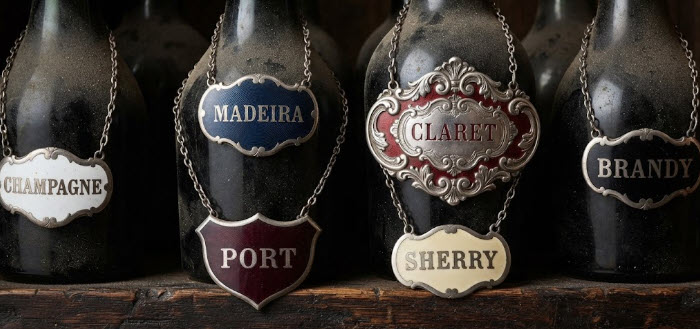
A Brief History of the Bottle Labels
The practice of identifying wine via hanging tags gained momentum in mid-18th-century England, a period that saw a massive rise in the consumption of port, madeira, sherry, and claret.
Before this era, wine was largely kept in wooden casks or stored in sturdy, bulbous glass bottles sealed with corks. Once brought to the dining table, however, these bottles or crystal decanters looked nearly identical.
Enter the Georgian silversmith. Around the 1730s and 1740s, early artisans began crafting small pieces of pierced or engraved silver to hang from thin chains around bottle necks. What started as a simple utility quickly evolved into a status symbol among the European aristocracy, showcasing wealth, refinement, and an appreciation for fine vintage dining.
Popular Materials and Designs
While sterling silver is by far the most common material found on the market today, collectors can find incredible variety across different mediums:
-
Silver and Old Sheffield Plate: The gold standard of bin labels. Early examples feature intricate rococo scrolls, grapevines, Bacchic motifs (celebrating Bacchus, the god of wine), and beautifully hand-engraved lettering.
-
Enamel and Porcelain: Popularized during the late 18th and 19th centuries, white enamel or Staffordshire porcelain labels offered a clean, legible surface, often framed with delicate gilt borders.
-
Bone and Ivory: Often found on simpler, country-house decanters, these organic materials lend a rustic, charming aesthetic to a collection.
-
Mother-of-Pearl and Glass: Rare and highly prized, these materials were often shaped into vine leaves or crescent moons, catching the candlelight on formal dining tables.
What to Look for When Collecting
If you are just starting your collection of antique wine labels, keep these key factors in mind to gauge value and authenticity:
-
Hallmarks and Maker’s Marks: For silver pieces, hallmarks are crucial. Look for maker’s marks, city marks, and date letters (especially on British silver). Prominent Georgian silversmiths like Phipson & Warden, Hester Bateman, or John Betts command significant attention from collectors.
-
The Name of the Wine: Labels featuring rare or obsolete beverage names—such as Bucellas, Vidonia, Calcavella, or Mountain—are often just as interesting (and sometimes more valuable) than standard labels like Port or Sherry.
-
Original Chains: Finding a label with its original matching link chain intact is a major bonus for authenticity and value.
-
Condition: Check for crispness in the engraving, cracks in enamel pieces, and overall structural integrity of the suspension loop.
Displaying Your Collection
One of the greatest joys of collecting antique wine labels is how easily they can be displayed. Because they are compact, many collectors mount them on velvet-backed shadow boxes, frame them in small wall displays, or style them alongside antique decanters on a bar cart or sideboard.
Whether you are drawn to the heavy gleam of Georgian silver or the delicate charm of Victorian enamel, antique wine labels offer a wonderful window into a bygone era of elegance and hospitality.