Collecting British Silver Napkin Rings: A Collector’s Guide
Often described as pieces of miniature tabletop architecture or “jewelry for the dining table,” antique silver napkin rings are a delightful and surprisingly deep area of UK horology and silversmithing. Emerging heavily during the Victorian era as formal dining evolved, they offer a brilliant entry point into antique collecting.
1. Best Dates to Collect
While napkin rings were occasionally made earlier, the golden age of the silver napkin ring spans from the mid-Victorian period through to the Edwardian era (circa 1870 to 1910).
Victorian (1837–1901): Look for heavily chased, engraved, or repoussé designs. Late Victorian pieces often feature whimsical themes, animals, or geometric motifs.
Edwardian (1901–1910): Often showcase refined elegance, lighter pierced work, and neoclassical styles (such as ribbons, bows, and garlands).
Art Deco (1920s–1930s): Highly collectible today, featuring geometric patterns, engine-turned designs, and bold, clean lines.
2. Designs: Crests vs. No Crests
When it comes to surface decoration, you will generally encounter two camps: blank/ornate surfaces and those bearing heraldry.
Plain or Ornate (No Crests): These are generally more versatile and commercially popular today because they fit seamlessly into modern table settings without tying the owner to a specific historical family. Heavily embossed florals, beaded edges, and child-specific designs (like nursery rhymes) are heavily sought after.
With Crests or Monograms: Engraved crests, monograms, or family mottos add a layer of provenance and historical storytelling. While some collectors love the genealogy aspect, a crest can occasionally limit the buyer pool if someone prefers a blank canvas. However, finely hand-engraved Victorian monograms are widely appreciated as works of art in their own right.
3. Best British Assay Offices (London, Sheffield, Exeter, & More)
The UK has one of the strictest and most reliable hallmarking systems in the world, making it easy to identify where and when a napkin ring was born.
London (Leopard’s Head): Generally commands strong baseline prestige, featuring crisp workmanship from top-tier metropolitan silversmiths.
Sheffield (Crown / Yorkshire Rose): Famed for its heavy association with the cutlery and Sheffield plate trades, Sheffield-assayed rings are robust, beautifully styled, and structurally exceptional.
Provincial Houses (Exeter, Chester, Newcastle, York): Highly prized by advanced collectors. Because provincial assay offices like Exeter (Castle mark) closed down long ago (Exeter ceased hallmarking in 1883), pieces originating from them are much rarer and often command a geographical or rarity premium.
4. Singularly vs. In Sets
Collecting Singularly: This is the most popular, affordable, and fun way to collect. It allows you to hunt for completely different styles—pairing an engine-turned 1920s band with a chunky Victorian scroll ring. It turns your collection into a diverse cabinet of curiosities.
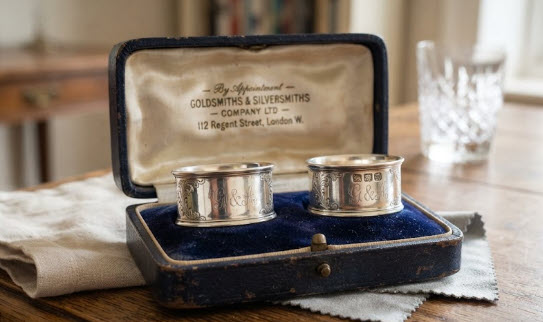
Collecting in Sets (Pairs, Quartets, or Sets of Six/Eight): True matching sets—especially in original fitted presentation cases—are considerably rarer and significantly more valuable. Because napkin rings were heavily used and easily separated over generations, finding a matching set of four or six in pristine condition is a major coup for collectors and commands top-tier auction prices.
5. Investment and Future Potential
Silver napkin rings occupy a wonderful sweet spot in the antique market: they are small to store, highly decorative, and still relatively accessible compared to large tea services or tankards.
Current Market: Prices typically range from accessible entry-level figures for standard late-Victorian pieces up to higher sums for rare provincial marks, figural designs (such as animals or children’s novelties), or matched sets.
Future Outlook: As formal dining habits shift, silver napkin rings are viewed more as decorative art objects or luxury gifts (christenings, weddings, anniversaries). While they are unlikely to make you a millionaire, stellar pieces—particularly rare makers, provincial assay offices, or immaculate Art Deco designs—tend to hold their value very well and appreciate steadily due to dwindling supply and strong international demand.